
You are hitting your goals. You are recognized, earning well, and from the outside, everything looks exactly as it should. So why does every morning feel heavier than the last?
If you have ever caught yourself quietly asking, “why do I feel burned out even though I’m successful,” you are not overreacting. What you are experiencing has a name, a pattern, and a way through.
Here is what this guide covers:
- Why high achievers experience burnout even when externally thriving
- The psychological causes behind this paradox
- What high-functioning burnout actually looks like, and why most people miss it
- Why rest, breaks, and vacations rarely solve the deeper issue
- A structured way to understand and begin addressing burnout despite career success
Why Do I Feel Burned Out Even Though I’m Successful?
Burnout does not always look like falling apart. For many high achievers, it looks like showing up, performing, and quietly deteriorating at the same time.
According to Eagle Hill Consulting’s November 2025 research, 55% of the U.S. workforce is currently experiencing burnout. What that number does not capture is how many of those people are also hitting every target and receiving praise while internally running on fumes.
The experience of burnout despite career success is not about working too much. It is about a growing disconnect between what you produce and what you actually feel.
| External Indicators | Internal Experience |
| Career progress and promotions | Persistent emotional exhaustion |
| Income growth and stability | Numbness toward achievements |
| Recognition from peers and leadership | Loss of motivation despite results |
| High productivity and output | Feeling like you are operating on empty |
That gap between column one and column two is where high-functioning burnout lives. And for many women in leadership, burnout in high achieving women often goes unspoken precisely because the outside narrative does not match the inside reality.
The Hidden Psychology Behind High-Functioning Burnout
High-functioning burnout is not the kind that shows up in missed deadlines or absenteeism. It hides behind a packed calendar and a polished exterior.
A 2025 clinical study by CEREVITY analyzed 127 tech founders and startup executives.
Nearly three-quarters reported persistent burnout symptoms, including exhaustion, cynicism, and reduced efficacy, for three months or longer, while simultaneously meeting or exceeding their business targets. Researchers named this “shadow burnout.”
| Category | High-Functioning Burnout | Traditional Burnout |
| Performance Level | Maintained or high | Declining visibly |
| Emotional State | Numb, disconnected, hollow | Overwhelmed and distressed |
| Visibility to Others | Hidden, mistaken for strength | Noticeable to team or management |
| Recovery Difficulty | Harder, because it is not recognized | Easier to identify and address |
Cognitive Dissonance in High Achievers
The internal experience of burnout despite career success creates a specific kind of conflict. Your mind holds two opposing truths at once: “I am successful” and “I do not feel successful.”
That conflict does not resolve with time. It deepens. The more you achieve without feeling it, the more disorienting the gap becomes.
Emotional Numbness and Reward System Fatigue
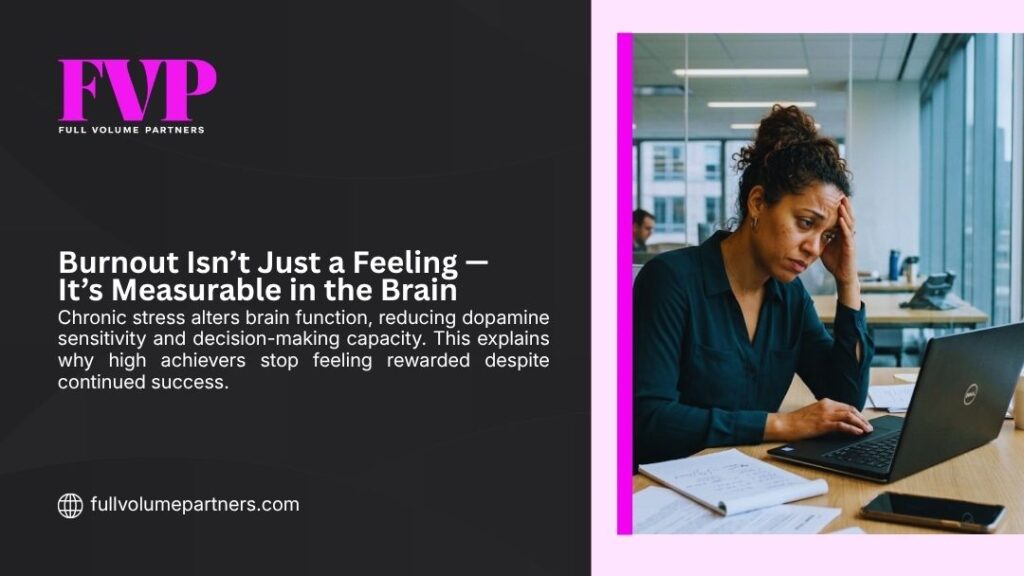
Why do achievements stop feeling rewarding? When the brain operates under sustained pressure, the dopamine response tied to accomplishment gradually dulls.
You chase the next milestone. You reach it. You feel nothing. Then you chase the next one, believing the feeling will eventually return. It rarely does on its own.
Why Success Itself Can Contribute to Burnout
Success creates its own pressure. The higher you climb, the more there is to protect, maintain, and justify.
| Healthy Achievement | Pressure-Driven Achievement |
| Motivated by curiosity and growth | Motivated by fear of losing ground |
| Work feels connected to purpose | Work feels like a performance to sustain |
| Setbacks are temporary and manageable | Setbacks feel like identity threats |
| Sustainable over the long term | Leads to escalating depletion |
The Identity Trap of High Achievers
For many high achievers, success is not just something they do. It is who they are. Identity has been built on performance, so any slowdown feels like a personal failure rather than a professional adjustment.
The McKinsey and LeanIn Women in the Workplace report, drawing on data from 124 organizations and over 9,500 employees, found that six in ten senior-level women frequently feel burned out, with burnout at its highest level in five years.
A key driver is not workload alone. It is the relentless pressure of maintaining an identity that has no room for exhaustion.
When your self-worth is wrapped around your output, rest feels dangerous. Slowing down feels like losing ground.
When Achievement Becomes a Coping Mechanism
For some, work has become a way to avoid sitting with emotional discomfort. Staying busy means not having to feel what lives underneath the busyness.
Over time, this accumulates. You are not just tired from what you have done. You are depleted from everything you have been pushing away.
Why Rest, Breaks, and Vacations Often Don’t Fix It
You come back from a week away feeling exactly the same as when you left. Maybe more drained. That is not a flaw in your recovery. It is a signal that what you are dealing with runs deeper than physical fatigue.
Mental fatigue, cognitive strain, and decision friction are now the leading indicators of burnout, surpassing workload volume for the first time.
| What People Try | Why It Often Fails | What Actually Helps |
| Sleep and rest | Physical rest does not address emotional depletion | Psychological safety and reduced cognitive load |
| Vacations | The system you return to is unchanged | Workload redesign and boundary-setting |
| Time off | Motivation does not return automatically | Reconnecting with meaning and purpose |
| Mindfulness apps | Surface-level tools for a structural issue | Identity and values recalibration |
The Difference Between Physical Fatigue and Emotional Burnout
Physical fatigue responds to sleep. Emotional burnout does not.
If you are waking after eight hours of rest and still feeling exhausted by 10am, the issue is not your sleep, but it’s the state your nervous system has been operating in for far too long.
Emotional burnout drains the part of you that makes work feel meaningful. Rest replenishes your body. It does not automatically rebuild your sense of purpose.
Why Motivation Does Not Return Automatically
When the internal reward system has been running on empty long enough, motivation does not simply bounce back after a break. The signal that once connected effort to fulfillment has been disrupted.
This is closely tied to feeling unfulfilled after career success, something many high achievers quietly wrestle with but rarely name out loud. The work has not necessarily changed. Your capacity to feel it has.
Key Signs You Are Experiencing High-Functioning Burnout
You may still be performing well externally. But internally, something feels off.
Recognizing the high-functioning burnout signs matters, because these signals are consistently dismissed as stress or a tough season, rather than indicators of something more systemic.
| Category | Signs to Watch For |
| Emotional | Numbness toward achievements, irritability without a clear cause, absence of satisfaction after completing goals |
| Cognitive | Brain fog on tasks you once handled easily, difficulty making decisions, inconsistent mental clarity |
| Behavioral | Overworking to compensate for internal emptiness, disengaging from life outside of work, procrastinating on things that once energized you |
Emotional Indicators
The most common high-functioning burnout symptoms show up as a flatness that does not match your external circumstances. Recognition lands without impact.
Milestones are reached and quickly forgotten. You celebrate with your team while feeling entirely disconnected from the moment.
Cognitive Indicators
Decision fatigue arrives earlier than it used to. Tasks that once came naturally now require visible effort. Mental sharpness becomes inconsistent, and the clarity you relied on feels unreliable.
Behavioral Indicators
Watch for patterns like working longer hours not from passion but to fill an emotional void. Pulling away from relationships, hobbies, and things that once brought joy is one of the clearest behavioral signals that burnout despite career success has taken root.

The Real Reasons You Feel Burned Out Despite Success
Burnout is rarely one thing, but it is usually a quiet accumulation of hidden pressures that compound over years.
| Surface Cause | Root Cause |
| Too much work | Identity built on unrelenting performance |
| Lack of time | No meaningful recovery built into the structure |
| High stress | Chronic stress normalized as the baseline of success |
| Low energy | Misalignment between effort and personal meaning |
Misalignment Between Work and Personal Meaning
When the work you do no longer connects to what you actually value, the energy required to show up becomes unsustainable. You can be objectively successful in a role that is quietly wrong for who you have become.
Many high achievers have shifted internally, in their values, priorities, and what they want from life, without giving themselves permission to acknowledge it.
Chronic Stress Normalization
One of the quietest contributors to burnout despite career success is the slow normalization of chronic stress. When high pressure becomes your baseline, you stop registering it as a problem. You assume this is simply what success feels like.
Professionals who are “quietly cracking” are 6.2 times more likely to develop full clinical burnout, precisely because the warning signs get rationalized away rather than addressed.
How High Achievers Begin Recovering from Burnout
Recovery from this kind of burnout is not about taking a break. It is about rebuilding the internal structure that makes sustainable high performance possible again.
| Short-Term Relief | Long-Term Structural Recovery |
| Rest and reduced workload | Identity recalibration and values reassessment |
| Delegation of tasks | Workload redesign with genuine boundaries |
| Digital detox | Rebuilding the connection between effort and meaning |
| Journaling | Ongoing coaching, strategic support, professional accountability |
Rebuilding Clarity Around Success
One of the first steps is redefining what success actually means to you now, not the version you constructed five or ten years ago.
That definition shifts over time. What drove you at 28 may no longer reflect who you are at 42. Burnout is often the signal that the gap between those two versions has grown too wide to ignore.
Restoring Boundaries and Cognitive Space
Decision fatigue is one of the fastest accelerators of burnout despite career success. Reducing low-stakes decisions, protecting uninterrupted blocks of time, and building structural recovery into your week are not luxuries. They are functional requirements for sustained performance.
Reconnecting Work With Meaning
The path forward involves aligning daily effort with what you genuinely value. For many high achievers, the experience of a lost sense of self after years of overachieving means that reconnecting with values requires intentional, guided reflection rather than a solo audit.
How to Prevent Burnout From Returning
Recovery matters. So does the architecture you build afterward, because burnout despite career success has a way of returning when the same systems that created it are left intact.
| Prevention Area | Approach |
| Work rhythms | Energy-based scheduling instead of time-based output |
| Identity | Separating self-worth from performance metrics |
| Recovery cycles | Building genuine rest into the weekly structure, not just annual vacations |
| Meaning | Regular alignment checks between your work and your values |
Building Sustainable Work Rhythms
High performance is not about doing more. It is about doing what matters from a state of genuine capacity rather than depletion. Shifting from time-based productivity to energy-based productivity changes the entire equation.
Detaching Identity From Performance
This is the deeper work. Reducing emotional dependency on achievement does not mean reducing ambition. It means building a sense of self that can sustain ambition without being dismantled by it.
FAQs
Why do I feel burned out even though I’m successful?
Because burnout at this level is rarely about workload alone. It is driven by emotional misalignment, identity pressure, and a reward system that has stopped responding to achievement. The gap between external success and internal experience is the root of it.
Can you be burned out and still perform well at work?
Yes, this is exactly what high-functioning burnout describes. Performance can remain high while internal energy, motivation, and emotional connection continue declining.
The two are not mutually exclusive, and that is precisely what makes this form of burnout so difficult to catch early.
Why does success stop feeling rewarding?
The brain’s reward response dulls under sustained pressure. When achievement becomes the default state rather than a peak experience, the emotional signal attached to it weakens. This is not a personal failure. It is a recognizable psychological and physiological pattern.
Is burnout just about working too many hours?
Mental fatigue and cognitive strain now outpace workload volume as the primary drivers of burnout. The volume of context-switching, digital noise, and decision pressure matters as much as hours worked.
What is high-functioning burnout?
It is a state where individuals continue performing at a high level while internally experiencing exhaustion, disconnection, and emotional depletion.
It is one of the most common and least recognized forms of burnout among leaders and founders, and it is most dangerous precisely because it remains invisible.
20+ Years Guiding Leaders Through Growth and Reinvention
The work you have built is real. So is what you are carrying underneath it.
Full Volume Partners is a transformational coaching practice built specifically for high-achieving women navigating burnout, identity shifts, and their next chapter.
With over 20 years of experience advising leaders through pivotal transitions and growth, this work goes beyond surface-level strategy. It goes to the root.
Here is what working with Full Volume Partners looks like in practice:
- Gaining clarity on why burnout despite career success has taken hold, beyond the obvious answers
- Rebuilding a definition of success that is sustainable, not self-depleting
- Reconnecting your ambition with your actual values, so effort and fulfillment stop working against each other
- Developing the structural and psychological changes that prevent burnout from returning
If you are ready to move from depletion to clarity, this is where that work begins. You do not have to rebuild your life to rebuild yourself. But you do need a guide who has helped women at exactly this crossroads before.Connect with Full Volume Partners today and take the first step toward reclaiming your energy, your clarity, and your next chapter.

