
Quick Answer: Accomplishing everything but still not being happy describes the gap between reaching your goals and actually feeling fulfilled by them. Achievement solves external problems like income, title, and recognition. Fulfillment depends on separate factors, including purpose, identity, and connection, that success does not automatically create on its own.

Feeling unhappy despite success is more common than you think and doesn’t necessarily mean that something is wrong with you. A 2024 Robert Half workplace survey found that 37% of women reported career dissatisfaction, compared to 32% of men, and that gap holds even as women continue to outpace men in college graduation rates.
If you have accomplished everything but are still not happy with the way your life actually feels, that gap has a name and a set of well documented causes behind it.
Why Accomplishing Everything Doesn’t Automatically Make You Happy
Accomplishing everything but still not happy describes the disconnect between reaching your goals and actually feeling fulfilled by them. Achievement solves external problems such as income, title, and recognition.
Fulfillment depends on separate factors, including purpose, identity, and connection, that success does not automatically provide.
If success changes your circumstances, why doesn’t it always change how you feel?
The short answer is that success and fulfillment run on different systems entirely. Success responds to performance. Fulfillment responds to alignment, the degree to which your daily life actually reflects what you value.
This is why so many people who have accomplished everything but still not happy describe the same confusion. On paper, the problem should be solved. In practice, the problem was never the one success was built to solve.
Success Can Improve Your Life Without Filling Every Emotional Need
Achievement is genuinely valuable. A promotion changes your income and your options, a degree opens doors that were previously closed. Selling a business creates real financial freedom.
The truth is, none of these accomplishments were ever designed to satisfy identity, belonging, or purpose on their own. They can support those things, but cannot manufacture them.
Many people quietly begin feeling unfulfilled after career success the moment the celebration ends and daily life resumes.
This is often the first sign of accomplishing everything but still not happy setting in. The milestone lands, and ordinary life quietly resumes underneath it, largely unchanged.
Two Common Reasons Success Feels Empty
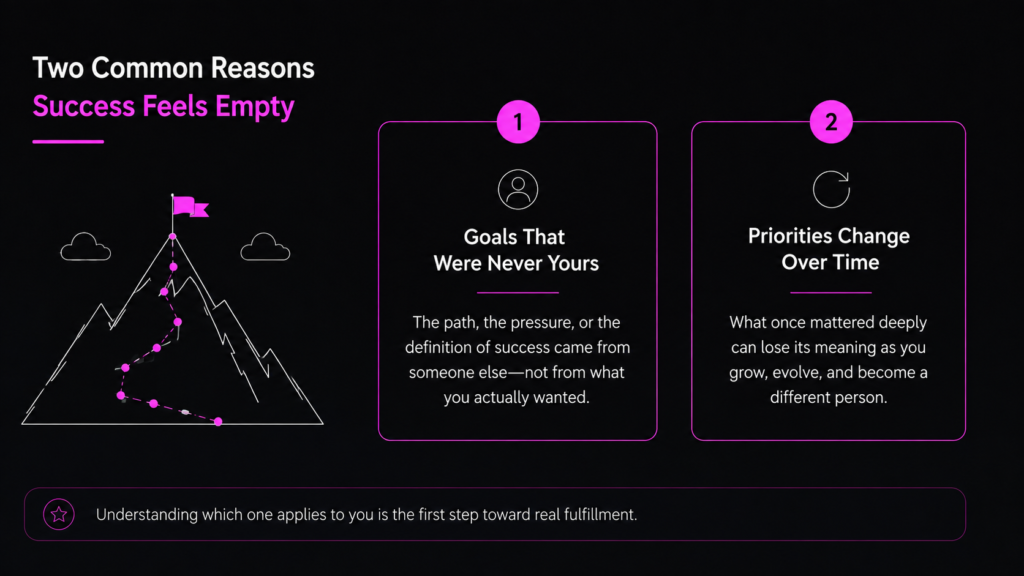
There are usually two explanations behind the experience of feeling accomplished but not happy, and they call for different responses.
Scenario one: You pursued goals that were never truly yours. The career path, the business model, or the lifestyle came from family expectations, industry norms, or a version of success you absorbed early and never questioned.
Scenario two: Your goals genuinely mattered when you set them, but your priorities have changed over time. What felt ambitious five years ago now feels routine, and the person who set that goal is not entirely the person living with the result.
Understanding why success doesn’t feel like enough often starts with figuring out which of these two scenarios actually applies to you.
Key Takeaway: Success changes your circumstances. Fulfillment depends on how well your life aligns with your values, relationships, identity, and sense of purpose.
What Is Really Keeping You From Feeling Fulfilled?
There isn’t one single reason people who have accomplished everything but still not happy feel this way. For most high achievers, it’s a combination of overlapping patterns, and naming the right one changes what actually helps.
| Possible Cause | Common Signs | What It Often Sounds Like Internally |
| Arrival Fallacy | The excitement fades within days or weeks of reaching the goal | “I thought this would feel different” |
| Depression and anhedonia | Persistent loss of interest or pleasure across work, relationships, and activities, not only disappointment after success | “Nothing feels rewarding anymore, even the things I used to enjoy” |
| Burnout | Persistent exhaustion, cynicism, and a flattened response to things that used to feel rewarding | “I’m tired of everything, even things I used to enjoy” |
| Workaholism | Constant busyness used to avoid stillness, difficulty resting without guilt | “If I’m not producing something, what am I even doing” |
| Loneliness | Success without corresponding depth in relationships, isolation despite visibility | “I have people around me, but almost no one really knows what’s going on” |
| Identity Drift | Uncertainty about who you are once the achievement is no longer the main event | “I don’t actually know what I want next” |
| Perfectionism | Achievements are quickly discounted, mistakes feel disproportionately important, and every success produces a higher standard. | “It only counts if I do even more next time” |
| Escape vs Express Self | The drive to achieve was rooted in avoiding a fear rather than expressing a genuine value | “Was I actually chasing this, or running from something else” |
Burnout and Workaholism Aren’t the Same Thing
Burnout is depletion. It shows up as exhaustion that rest does not fully resolve, along with reduced motivation and a sense of going through the motions.
Workaholism is a pattern, not a symptom. It is the habit of using constant productivity to manage internal discomfort, often long before exhaustion sets in. Someone can be a workaholic without yet being burned out, and burned out without identifying as a workaholic at all.
Both can exist underneath the same experience of accomplishing everything but still not being happy, which is exactly why naming the right one changes what actually helps.
Have Your Goals Become Your Identity?
When self-worth is tied to output, every accomplishment briefly resets the standard instead of settling it. Perfectionism plays a direct role here. The goal gets reached, quietly downgraded, and replaced before the achievement has a chance to actually register.
Research professor Brené Brown has described perfectionism as rooted in seeking approval, often shaped by being praised for achievement from an early age rather than for who you are. As she puts it, “I am what I accomplish and how well I accomplish it.”
That belief is what keeps the finish line moving, since the standard being chased was never really about the goal itself.
This is identity drift in practice. The achievement arrived, but the sense of who you are outside of your career has not caught up with it.
Were You Running Toward Something or Away From Something?
Not every goal is chosen the same way. Some are pursued to express something genuinely true about what you value. Others are pursued to escape a feeling, prove someone wrong, or avoid a specific fear.
A few honest questions tend to surface which one applies:
- Was I chasing approval?
- Was I proving someone wrong?
- Was I avoiding failure?
- Or was this genuinely meaningful to me on its own terms?
Neither answer is a character flaw. But only one of them tends to produce lasting satisfaction once the goal is reached. This pattern is closely tied to losing your sense of self after years of overachieving, where the achievement itself stops feeling like the point.
The Suppression-Anxiety Cycle
Achievement can become an unconscious way to manage difficult emotions. When people constantly suppress discomfort by staying busy or productive, they often reduce their capacity to feel positive emotions as well.
Emotions do not suppress selectively. Numbing the hard ones tends to numb the good ones too, which helps explain why some of the most accomplished people describe feeling flat rather than distressed.
This cycle is one of the more overlooked drivers behind accomplished everything but still not happy, since the numbness rarely announces itself as a problem worth addressing.
Why Have I Accomplished Everything but Still Not Happy?
A 2023 Harvard Graduate School of Education report found that nearly three in five young adults reported lacking meaning or purpose in their lives, despite outward markers of success.
That’s a large enough share that the feeling isn’t random, and psychology offers several specific explanations for why it happens.
What Is the Arrival Fallacy?
The arrival fallacy is the belief that reaching a specific goal will produce lasting happiness.
Positive psychologist Tal Ben Shahar, who coined the term, put it this way in his book Happier:
“Happiness is not about making it to the peak of the mountain, nor is it about climbing aimlessly around the mountain, happiness is the experience of climbing toward the peak.”
Researchers who study this pattern have found that people consistently overestimate how good a milestone will feel and underestimate how quickly that feeling fades.
This is why a promotion that felt career defining in January can feel routine by March. The anticipation almost always carries more emotional weight than the achievement itself delivers.
Why Your Brain Quickly Adapts to Achievement
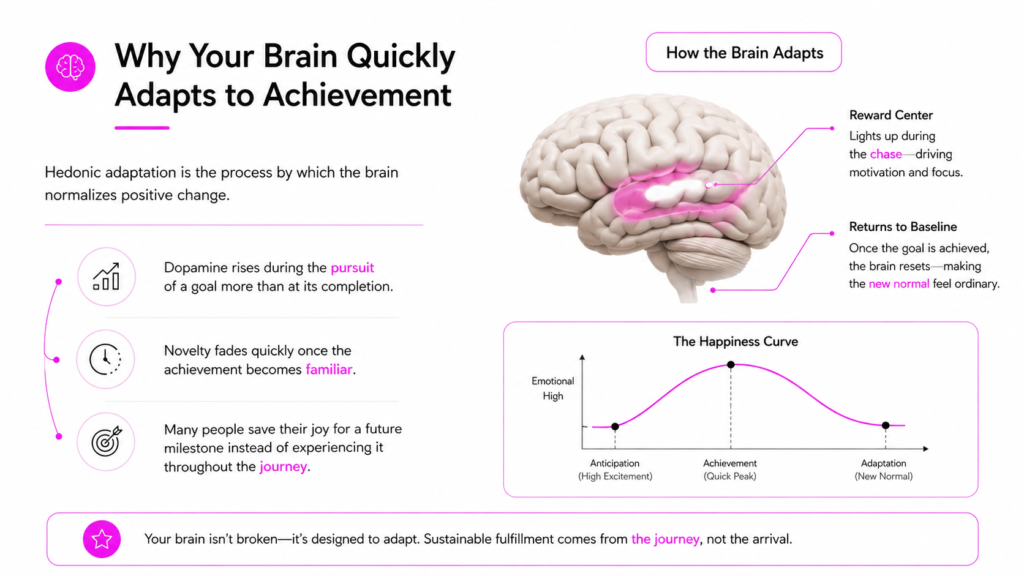
Hedonic adaptation is the process by which the brain normalizes positive change. Dopamine rises during the pursuit of a goal more than at its completion, and novelty fades quickly once the achievement becomes familiar.
Many people unknowingly save their joy for a future milestone instead of experiencing it throughout the journey. The next goal always looks like the one that will finally feel different.
Achievement Can Become a Shield Instead of a Solution
For some high achievers, accomplishment becomes an unconscious way to avoid shame, loneliness, insecurity, uncertainty, or low self-worth. The busier the calendar, the less room there is to sit with an uncomfortable feeling.
Achievement itself is not unhealthy. Using achievement to avoid emotions is a different pattern entirely, and it tends to keep the underlying feeling in place rather than resolving it.
Why Do I Feel Guilty for Being Unhappy After Success?
Feeling unhappy after achieving your goals can bring a second, quieter emotion with it: guilt.
You may look at your career, income, recognition, family or opportunities and think you have no right to feel dissatisfied. Other people may even describe your life as something they wish they had. That can make it difficult to admit that something still feels absent.
But gratitude and dissatisfaction can exist at the same time. You can appreciate what you have built while recognizing that it no longer meets every emotional need.
Acknowledging that gap does not make you ungrateful, selfish or unsuccessful.
Guilt becomes unhelpful when it stops you from examining what is actually missing. Instead of treating the feeling as evidence that you have failed, consider it information.
It may point toward a need for deeper connection, more meaningful work, a healthier relationship with ambition, or a definition of success that better reflects who you are now.
Why Success Stops Feeling Like Enough
| What Changes | What Usually Doesn’t |
| Income | Self-worth |
| Job title | Identity |
| Public recognition | Emotional security |
| Lifestyle and comfort | Sense of purpose |
A 1978 study published in the Journal of Personality and Social Psychology compared 22 major lottery winners against a matched control group and 29 people living with paralysis from accidents.
On a 5-point happiness scale, lottery winners scored an average of 4.00, barely ahead of the control group’s 3.82, and winners actually reported taking less pleasure from small, everyday moments than people who hadn’t won anything at all.
Positive psychologist Tal Ben Shahar describes this same pattern from a different angle. Happiness, he argues, is closer to the experience of climbing toward a goal than the moment of arriving at it.
Your brain is built to adapt quickly to good news. That is not a flaw in your character, it is a predictable feature of how achievement and emotion actually interact.
A Short Fulfillment Check-In
You do not need to make an immediate career or life change to begin understanding what feels missing. Start by answering these questions honestly:
- Which parts of my current definition of success did I consciously choose? Consider which goals reflect your own values and which may have come from family expectations, professional culture or social comparison.
- What did I expect this achievement to change emotionally? Were you expecting it to create confidence, security, belonging, freedom or a stronger sense of identity?
- Which relationships or personal needs received less attention during the pursuit? Notice what may have been postponed while work, productivity or achievement remained the priority.
- Am I pursuing my next goal from meaning, fear, habit or external approval? More than one motivation may be present, but identifying the strongest one can clarify whether the next goal is likely to feel different.
- What would a fulfilling week look like if nobody else were evaluating it? Think beyond job titles, income and visible accomplishments. Consider how you would spend your time, who you would spend it with and how you would want ordinary days to feel.
Your answers do not need to produce an immediate solution. Their purpose is to reveal whether your current life reflects what matters to you now, not only what mattered when you first began pursuing success.
How to Feel Fulfilled Without Giving Up Your Ambition
The solution isn’t becoming less ambitious. It’s redirecting ambition toward things that actually hold up over time.
Redefine Success Around Your Values
Most people never actually choose their definition of success. It gets installed early, by a parent’s approval, an industry’s unspoken scoreboard, or a version of “making it” that was already decided before anyone thought to question it.
Redefining success starts with noticing which parts of that definition were genuinely yours, and which ones were just running in the background the whole time.
This single distinction tends to cut through a lot of the confusion behind accomplishing everything but still not being happy, since it separates what you actually want from what you were taught to want.
Invest in What Predicts Long Term Well Being
Research consistently points to the same small set of pillars behind durable satisfaction, regardless of income or title.
- Relationships that go beyond proximity to your professional life
- A sense of meaning that isn’t contingent on outcomes
- Physical health treated as a foundation, not a reward
- Contribution to something beyond personal output
- Ongoing growth that isn’t tied to a title or milestone
Celebrate Progress Instead of Waiting for the Finish Line
Waiting for the next milestone to feel satisfied keeps satisfaction permanently out of reach. Noticing progress while it is happening, rather than only at the finish line, is one of the more reliable ways to interrupt that pattern.
From Achievement Chasing to Lasting Fulfillment
| Instead of… | Try… |
| Constantly raising the bar after every win | Naming and actually celebrating meaningful progress |
| Measuring your worth by output | Building an identity that exists outside of work |
| Waiting for happiness to arrive later | Locating meaning inside the process itself |
| Comparing your timeline to everyone else’s | Defining success using your own stated values |
Accomplished Everything but Still Not Happy? Here’s What to Remember
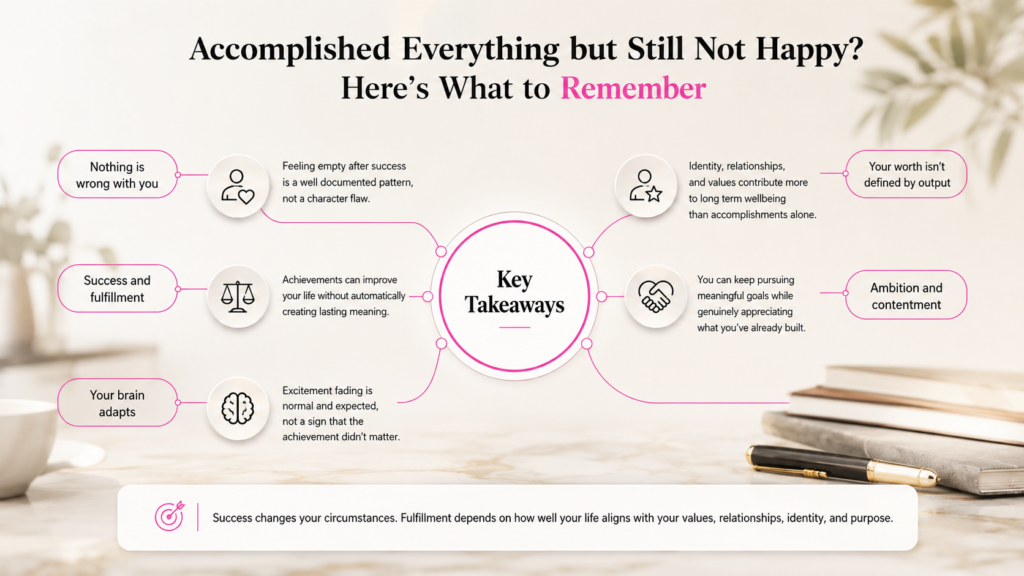
If you take one thing from this, let it be this: accomplishing everything but still not being happy is a common, explainable experience, not a personal failure.
Feeling this way does not mean you need to walk away from your ambition. It means the definition of success driving that ambition may need an update.
| Remember This | Why It Matters |
| Nothing is wrong with you | Feeling empty after success is a well documented pattern, not a character flaw |
| Success and fulfillment are different systems | Achievements can improve your life without automatically creating lasting meaning |
| Your brain adapts to success quickly | Excitement fading is normal and expected, not a sign that the achievement didn’t matter |
| Your worth isn’t defined by your output | Identity, relationships, and values contribute more to long term wellbeing than accomplishments alone |
| Ambition and contentment can coexist | You can keep pursuing meaningful goals while genuinely appreciating what you’ve already built |
Frequently Asked Questions
Is It Normal to Have Accomplished Everything but Still Not Happy?
Yes, feeling empty after a major achievement is a well documented psychological pattern rather than a personal shortcoming.
Many people who have accomplished everything but still not happy experience it because of hedonic adaptation and the arrival fallacy, both of which affect high achievers at a similar rate regardless of how significant the goal was.
Why Do I Keep Chasing Bigger Goals?
Chasing a bigger goal after the last one fails to deliver lasting satisfaction is a common response to hedonic adaptation. Each new target briefly restores a sense of progress, which is why the underlying pattern tends to repeat unless the root cause is addressed directly.
This pattern shows up constantly in people describing accomplished everything but still not happy, and it’s often the moment feeling lost after achieving goals that turns from a passing thought into the actual question worth answering.
Can Success Actually Make You Feel Unhappy?
Success itself doesn’t create unhappiness, but the gap between external achievement and internal fulfillment can. Many people search for answers using phrasing like successful but unhappy, what’s wrong with me, when the real issue is a mismatch between what was achieved and what was actually needed.
Successful but Unhappy, What’s Wrong With Me?
Nothing is clinically wrong with you. This feeling usually reflects a solvable mismatch between external achievement and internal fulfillment rather than a flaw, and it’s one of the most common variations of feeling accomplished but still not happy.
How Do I Stop Tying My Self Worth to Achievement?
Separating self-worth from achievement starts with identifying which parts of your identity currently depend entirely on output. Rebuilding value around relationships, personal values, and interests outside of work reduces how much emotional weight any single goal has to carry.
Is This Burnout or Something Else?
Burnout involves depletion, cynicism, and reduced motivation tied to sustained pressure. Feeling accomplished but still not happy can occur without burnout at all, since it’s often driven by the arrival fallacy or identity drift rather than exhaustion specifically.
If you suspect you feel burned out even though you’re successful, that distinction is worth examining directly.
Can You Be Ambitious and Still Feel Fulfilled?
Yes, ambition and fulfillment aren’t opposites. The two conflict only when ambition is used to avoid difficult emotions or when success is defined entirely in terms nobody chose for themselves.
In practice, most people who feel accomplished but still not happy are not being asked to choose between the two. They are being asked to define both on their own terms.
You’ve Accomplished a Great Deal. Your Sense of Direction Deserves the Same Attention.
Full Volume Partners has spent more than 20 years helping high achieving women navigate reinvention, growth, and next chapter leadership, without asking them to dismantle everything they’ve already built to get there.
The work goes beyond a single conversation or a generic framework. It focuses on:
- Understanding why accomplishment hasn’t translated into fulfillment at this specific stage of your career
- Rebuilding a definition of success that includes both ambition and meaning
- Reconnecting your goals with your actual values, so achievement and fulfillment stop working against each other
- Creating a forward direction that doesn’t require walking away from what you’ve already built
If you’ve accomplished everything but still not happy with where things stand, that recognition is worth taking seriously. You do not have to restart your life to feel differently about it. The right guidance is what turns that recognition into an actual next step.
Connect with Full Volume Partners today and start building a definition of success that finally includes how you feel, not only what you’ve achieved.

