
Article Summary
- Six in 10 senior-level women report frequently feeling burned out, the highest level ever recorded, versus five in 10 senior-level men.
- Recovery does not require stepping away from your role. A structured 30-60-90 day approach rebuilds energy, boundaries, and delegation while you keep leading.
- Senior-level women now report burnout at the highest rate ever recorded, driven largely by invisible emotional labor and caregiving demands that never show up on a job description or performance review.
- A vacation will not fix executive burnout on its own. The relief fades within one to two weeks of returning to work, which is why lasting recovery depends on structural changes, not one-time rest.
Executive burnout recovery for women is the structured process of restoring energy, mental clarity, and professional identity after chronic workplace stress reaches the point of exhaustion and reduced effectiveness.
It differs from general stress management because it addresses pressures specific to senior women: visible leadership duties stacked on invisible emotional labor and caregiving demands.
Recovery does not require leaving a leadership role. It requires changing how you define success, rest, and boundaries.
Executive Burnout Recovery for Women Starts With Understanding What Burnout Really Is
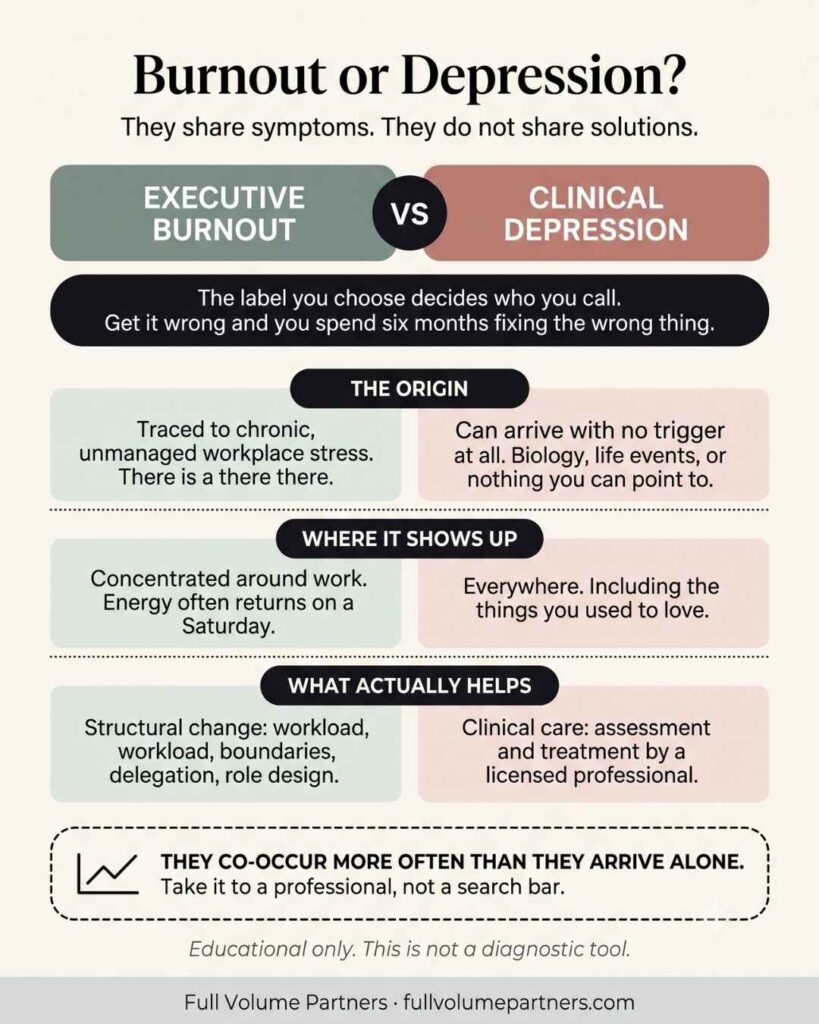
Burnout is not the same as a hard week or a demanding quarter. The World Health Organization classifies it as an occupational phenomenon, a specific result of chronic workplace stress that has not been successfully managed.
It shows up in three ways: exhaustion, growing mental distance from your work, and a drop in how effective you feel.
For women in senior roles, these symptoms build quietly. You keep performing, keep showing up, keep being the person everyone relies on.
That is exactly why women executive burnout symptoms get missed for months, sometimes years, before anyone, including the woman experiencing them, names what is happening.
Recognizing this early is the first real step toward burnout recovery for high-achieving women, long before a crisis forces the issue.
| Ordinary Stress | Temporary Fatigue | Executive Burnout | |
| Trigger | A single demanding event or deadline | A busy stretch or short-term overload | Sustained, unmanaged pressure over months or years |
| Energy | Elevated, on edge | Low, but recoverable with sleep | Depleted even after rest |
| Recovery time | Days | One to two weeks | Three months to over a year, depending on severity |
| Motivation | Intact | Slightly reduced | Significantly diminished or absent |
Why High-Achieving Women Often Miss the Early Signs
Perfectionism plays a role here. So does a career built on being the reliable one, the person who solves problems instead of creating them. Powering through discomfort becomes a learned skill long before it becomes a liability.
The pattern often looks like an executive who performs flawlessly in every meeting, then feels nothing when a project she worked toward for a year finally lands.
If that sounds familiar, the signs of burnout in high achieving women rarely look like the collapse most people picture.
Executive Burnout Is More Than Physical Exhaustion
Physical tiredness is only one layer. Cynicism toward work you used to care about, emotional numbness, and a measurable drop in how effective you feel at your own job belong to the same pattern. Rest alone rarely resolves all three at once.
Why Women Leaders Experience Burnout Differently Than Men
Many women leaders carry two full-time jobs: the one in their organization, and the invisible one nobody puts on the org chart. This structural gap is exactly why executive burnout recovery for women looks different than recovery advice built for men.
Globally, women perform roughly three-quarters of all unpaid care work, and the IMF estimates women handle about two more hours of unpaid labor per day than men. That gap does not disappear when a woman becomes a VP or a CEO.
Inside the organization, the same pattern repeats. Women managers are far more likely than men to provide emotional support to their direct reports, and that work rarely appears on a performance review.
| Visible Leadership Responsibilities | Invisible Leadership Labor |
| Strategic planning and decision-making | Managing team morale and conflict |
| Budget ownership and reporting | Mentoring junior staff informally |
| Public-facing leadership and client relationships | Organizing culture initiatives and team recognition |
| Formal delegation of tasks | Absorbing emotional labor from direct reports |
| Board and stakeholder updates | Managing caregiving responsibilities at home |
The Hidden Emotional Tax of Leadership
Emotional labor in leadership rarely shows up on a job description, yet it shapes how much energy is left at the end of a workday.
Regulating your reactions in high-stakes meetings, absorbing a team’s stress, and staying available for mentorship all draw from the same limited reserve that strategic thinking depends on.
Left unaddressed, this pattern becomes one of the clearest leadership burnout symptoms to watch for, especially in women who have spent years being the person a team leans on.
Why Ambitious Women Struggle to Rest Without Guilt
In one workplace survey, nearly all the women who took part said they worried that using flexible work arrangements would damage their promotion chances.
That fear reflects a documented pattern in how flexibility and ambition get judged differently, and it directly shapes work-life balance for women executives at every level.
When self-worth gets tied to output, rest can feel like falling behind. That dynamic, more than workload alone, is often what separates perfectionism and burnout in women leaders from a simple case of being busy.

Executive Burnout Recovery for Women
Recovery is not about getting back to who you were before burnout. It is about building a version of success that does not require running yourself into the ground to sustain it.
Executive burnout recovery for women tends to move through five stages, and skipping ahead usually backfires. Each stage builds the capacity the next one needs.
| Stage | Goal | Common Challenges | Practical Actions |
| 1. Stabilization | Stop the immediate energy drain | Guilt about stepping back | Cut one recurring low-value commitment |
| 2. Restoration | Rebuild mental and physical capacity | Believing one vacation will fix it | Protect a sleep window and one screen-free block daily |
| 3. Boundary rebuilding | Set limits without losing influence | Fear that saying no damages credibility | Redefine availability in writing with your team |
| 4. Identity redefinition | Separate self-worth from output | Grief over an identity built on achievement | Name one value unrelated to performance |
| 5. Sustainable leadership | Stay ambitious without repeating the cycle | Old habits resurfacing under pressure | Build a structural check-in to catch relapse early |
Stage 1: Stabilization and Reducing Immediate Energy Drain
This stage is about subtraction, not optimization. Identify what is currently draining you the fastest, then remove or delegate it first.
Stage 2: Restoring Mental, Emotional, and Physical Capacity
Sleep and a single vacation are not enough on their own. Real restoration requires consistent daily recovery, not one large event you hope will carry you through the next twelve months.
Stage 3: Rebuilding Boundaries Without Losing Influence
Boundaries fail when they stay unspoken. Telling your team explicitly when you are and are not available protects your recovery and, in most cases, earns more respect than constant availability did.
Stage 4: Redefining Identity Beyond Achievement
This stage carries real grief. If your sense of self has been built on output for fifteen or twenty years, stepping back from that pace can feel like losing part of who you are.
As Arthur C. Brooks, Harvard Business School professor and author of From Strength to Strength, advises:
“You will be happier and more successful if you shift your focus from achievement to fulfillment.”
Women working through the lost sense of self after years of overachieving often describe this stage as the hardest and the most necessary.
Stage 5: Creating a Sustainable Leadership Model
The goal here is not less ambition. It is a version of ambition that does not require self-sacrifice to sustain. That distinction is what separates temporary relief from real executive burnout recovery for women, and it is the difference most generic advice misses entirely.
How to Recover From Executive Burnout While Still Working
Most women executives cannot disappear for six months. Recovery has to happen alongside real deadlines and real teams.
Generic burnout advice assumes you can step away completely. Real executive burnout recovery for women has to work alongside your calendar, not instead of it, which means the plan needs structure.
| Phase | Focus | What Changes |
| First 30 days | Stabilize energy and cut immediate drains | Remove one recurring low-value commitment, protect sleep, delegate one recurring task |
| Days 31 to 60 | Rebuild boundaries and structure | Set explicit availability windows, redesign your calendar around energy peaks |
| Days 61 to 90 | Reinforce new habits into your leadership style | Delegate a second layer of responsibility, revisit your definition of a good week |
Prioritize Energy Management Instead of Time Management
Time management assumes every hour holds equal value. It does not. How to recover from burnout while working starts with tracking energy, not just hours, and protecting your highest-capacity windows for the decisions that actually need you.
What Women Leaders Should Delegate First
Start with administrative work, low-impact meetings, and non-essential approvals. These tasks drain time without requiring your specific judgment, which makes them the fastest wins.
- Administrative and scheduling tasks
- Meetings where your presence is not required for the decision
- Approvals a trusted team member can make with clear guardrails
- Emotional labor shared across a leadership team instead of absorbed by one person
Building Recovery Habits That Fit an Executive Schedule
Small, repeatable habits outperform a complete lifestyle overhaul. A protected 20-minute block or a consistent shutdown time will outlast a dramatic short-term change most executives cannot sustain past week three.
Preventing Burnout Relapse and Building Sustainable Success
The habits that created your success in one season can quietly become liabilities in the next. Preventing burnout relapse after recovery means watching for old patterns before they fully return, not waiting for a second collapse.
This is the stage where executive burnout recovery for women either becomes permanent or quietly reverses.
| Old Leadership Habit | Sustainable Leadership Practice |
| Always available | Protected focus time with clear boundaries |
| Individual ownership of everything | Delegated ownership with clear accountability |
| Perfectionism as the standard | Progress as the standard |
| Rest only after everything is finished | Rest built into the weekly schedule regardless of workload |
Recognizing the Early Warning Signs of Relapse
Watch for irritability returning, sleep disruption creeping back, and a growing sense of resentment toward work you previously managed without difficulty.
These signals tend to arrive quietly, which is exactly how so many executives end up being burned out and not know it until performance or health forces the issue.
Can Ambition and Wellbeing Coexist?
Despite reporting higher burnout than men, women in leadership consistently report higher motivation to pursue further growth, and that gap is largest among women with children (Gallup, 2026).
Ambition and burnout are not the same thing. Sustainable executive burnout recovery for women simply requires a different operating model than the one that got you here.
Executive Burnout Recovery for Women FAQ
Can executive burnout recovery for women happen without quitting a job?
Yes, reducing energy drains, rebuilding boundaries, and delegating strategically are usually more realistic than a full career break, and they work for most women who do not want to step away entirely.
How long does executive burnout recovery usually take?
Recovery commonly takes three to six months for moderate burnout, and over a year for severe cases. Progress rarely moves in a straight line, and setbacks are normal, not a sign of failure.
Why doesn’t a vacation fix executive burnout?
Burnout comes from chronic, unmanaged patterns, not short-term tiredness. The mental benefits of a vacation typically fade within one to two weeks of returning to the same workload that caused the exhaustion.
What are the first signs that burnout is returning?
Irritability, disrupted sleep, emotional numbness, and growing resentment toward tasks that used to feel manageable are usually the earliest indicators, arriving well before performance visibly declines.
Is burnout recovery different for women founders and entrepreneurs?
Founders and entrepreneurs frequently experience an overlap between business performance and personal identity that employed executives do not face.
That overlap means leadership burnout recovery for founders needs to address identity and business risk together, which is where executive burnout coaching for women adds the most value.
The Path Forward Looks Like Leadership, Not Retreat
Full Volume Partners works directly with high-achieving women executives and founders navigating burnout, identity shifts, and the question of what leadership looks like on the other side of recovery, without asking them to dismantle everything they built to get here.
The advisory work is built around what actually moves the needle for senior women, not generic coaching:
- A clarity-first approach that turns a vague sense of depletion into a specific, actionable recovery plan
- Hands-on, embedded partnership rather than a one-off engagement you never hear from again
- Customized frameworks built around your stage, your industry, and your actual constraints, not a template pulled from a general leadership course
- More than 20 years of experience helping high-achieving women navigate reinvention and growth without losing the ambition that got them here
If the exhaustion you read about in this guide feels familiar, that recognition is worth acting on. Executive burnout recovery for women does not require rebuilding your entire life. It requires the right support to rebuild the parts that are quietly costing you the most.
Connect with Full Volume Partners today and start the conversation.

