
Being burned out and not knowing it is far more common than most professionals ever realize.
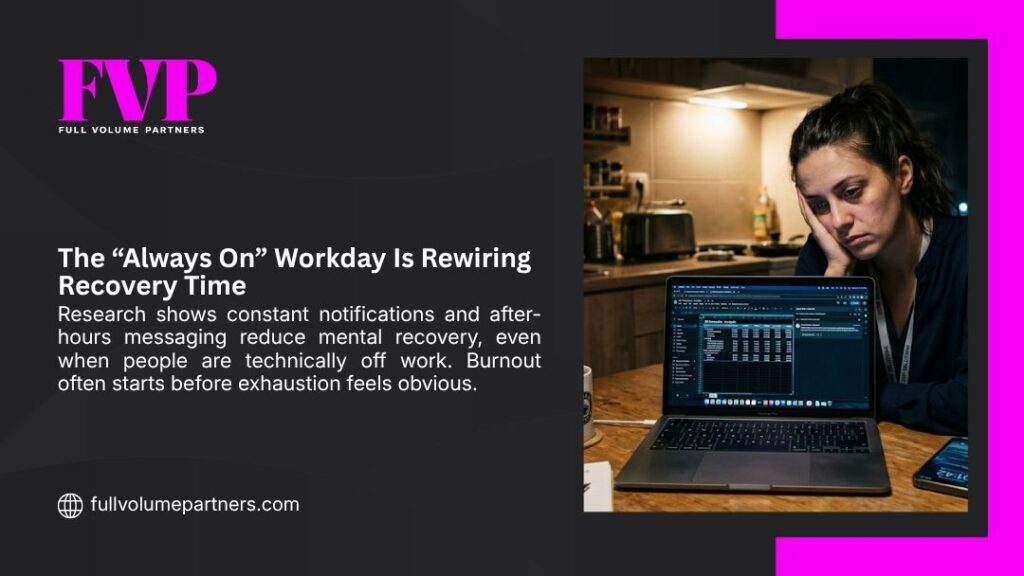
You are still hitting deadlines, still answering messages, still performing, but something underneath has been quietly wearing down for months, and you have been calling it stress, tiredness, or a rough season.
This guide covers what hidden burnout actually looks like, how it differs from stress and exhaustion, why driven professionals are especially likely to miss it, and what to do if the signs feel familiar.
Can You Be Burned Out and Not Know It?
Yes, you can be burned out and not know it. Burnout is a gradual process rather than having a one-night mental shutdown, and many people often miss early warning signs.
This can be mistaken with chronic exhaustion for just being “tired” or “stressed”.
It is characterized by a slow, progressive exhaustion where you continue to function at high levels, but internally you are depleted. This leads to a “functional but dead inside” feeling.
Among HR leaders surveyed, 19% estimated that at least 50 out of every 100 employees are experiencing it right now without anyone around them knowing.
Being burned out and not knowing it is not a personal failure. It is what happens when capable people keep going long past the point where they should have slowed down.
What Burnout Looks Like Before It Becomes Obvious
The early stage is quiet. You are still functioning. Still productive. But things feel heavier than they used to.
- Tasks that once felt natural now require visible effort
- Work that used to energize you starts to feel neutral or obligatory
- Small interruptions trigger more irritation than they should
- You get through the day, but you do not feel restored by the evening
This is what researchers sometimes call shadow burnout, the kind that hides behind performance. You look fine. You may even be praised for your output. But internally, the tank is draining.
Why People Do Not Recognize Burnout in Themselves
There are a few consistent reasons this happens.
The first is misattribution.
Most people assume that if they were truly burned out, they would not be able to function at all. Because they are still performing, they dismiss the signs as temporary stress or a rough patch.
The second is normalization.
In high-pressure environments, fatigue and emotional flatness become background noise. Everyone around you seems to feel the same way, which makes your experience harder to flag as unusual.
The third is identity.
For founders and driven professionals, pushing through difficulty is core to how they see themselves. Acknowledging burnout can feel like admitting weakness, which delays recognition even further.
Signs You Might Be Burned Out Without Realizing It
Being burned out and not knowing it often hides inside the behaviors that look like competence. Perfectionism. Overdelivery. Being the first one in and the last one out.
| Symptom | What It Actually Feels Like |
| Persistent fatigue | Tired even after a full night of sleep |
| Brain fog | Slower thinking, decisions take longer |
| Irritability | Disproportionate reactions to small things |
| Emotional flatness | Less engagement with things you once cared about |
| Cynicism | Detachment from work, people, or purpose |
| Reduced motivation | Getting through tasks rather than engaging with them |
| Sleep disruption | Difficulty falling asleep or waking up unrefreshed |
Research from DHR Global found that 83% of white-collar knowledge workers are experiencing at least some degree of burnout.
More than half are masking that experience, presenting as productive while privately running on empty.
If any column in that table sounds familiar, you may already be feeling burned out even though successful without having given that experience a name yet.
Emotional Signs People Dismiss
Emotional burnout does not always look like visible distress. It often looks like the opposite.
You are not sad or panicking, but you just feel switched off.
Tasks that once mattered feel like obligations, interactions that used to energize you now feel draining. You show up, but you are not really there.
That emotional distance is one of the most consistent early signs. It gets dismissed because it is quiet, and quiet does not feel like a crisis.
Mental and Cognitive Signs
Burnout changes how you think, not just how you feel.
- Decision-making slows down, even for simple choices
- Concentration becomes harder to sustain across longer tasks
- Memory gaps appear more frequently than before
- Strategic or creative thinking starts to feel like heavier lifting
Being burned out and not knowing it often shows up first in cognitive performance. People notice they are working harder for the same output, but they attribute it to a difficult project rather than a deeper pattern.
Physical Signs That Can Be Mistaken for Normal Tiredness
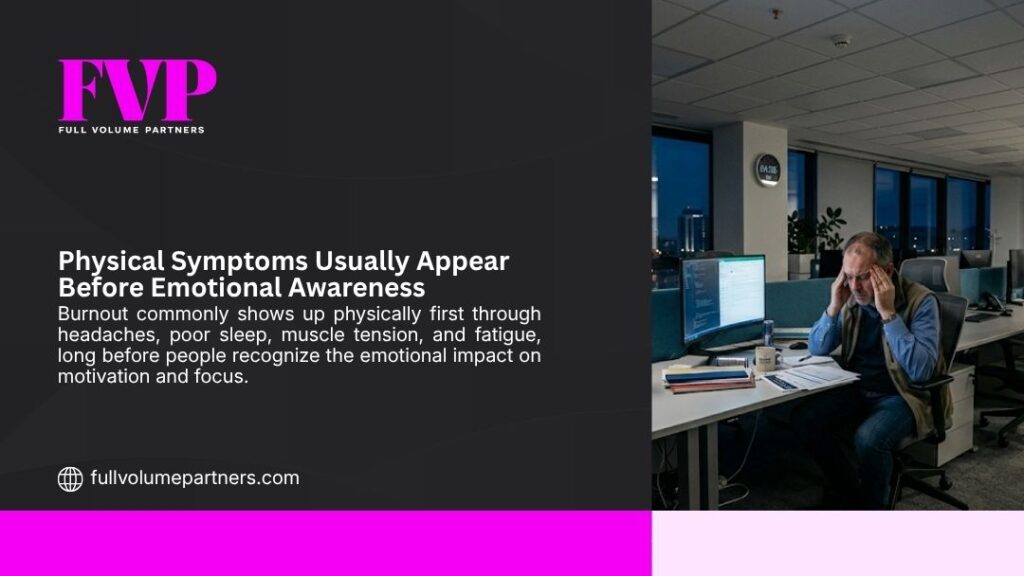
The body signals burnout before the mind fully registers it.
| Physical Sign | What Gets Dismissed As |
| Waking up unrefreshed | “I just need better sleep” |
| Frequent headaches or tension | “Work stress” |
| Low energy throughout the day | “I need more coffee” |
| Getting sick more often than usual | “Bad luck this season” |
| Feeling physically heavy or slow | “Not enough exercise” |
Burnout vs Stress vs Exhaustion vs Decision Fatigue
A lot of confusion comes from mixing up states that feel similar but have different causes and recovery patterns.
| Condition | Duration | Main Trigger | Recovery Pattern | Emotional Effect |
| Burnout | Chronic | Prolonged work pressure | Slow, requires structural change | Detachment, cynicism |
| Stress | Temporary | Specific demand or deadline | Resolves when pressure lifts | Urgency, tension |
| Exhaustion | Variable | Short-term overexertion | Responds well to rest | Tiredness, low energy |
| Decision fatigue | Daily | Too many choices | Recovers overnight | Indecision, impulsivity |
Burnout vs Stress
Stress feels like pressure. There is urgency, a clear trigger, and usually a sense that it will end when the project ends. Burnout does not have a clear endpoint. It is not tied to one event. It is the result of sustained pressure that was never properly processed.
A busy week that ends when the deadline passes is stressful. A flatness that keeps returning, project after project, month after month, is something else entirely.
Burnout vs Exhaustion
Exhaustion responds to rest. One good weekend or a real break and you feel like yourself again. Burnout tends to come back. You take time off, and the heaviness returns within days of going back to work.
“Taking one day off helped. But the heaviness came back immediately.” If that sounds familiar, rest alone is not the solution.
Burnout vs Decision Fatigue
Decision fatigue is situational, as it builds throughout the day when you have made too many choices.
Burnout is broader, as it is the exhaustion that is already present when you wake up, before the day has started.
A small daily decision feels impossible, not because of the decision itself, but because you are already running on empty.
Why Burnout Goes Unnoticed in High Performers and Busy Professionals
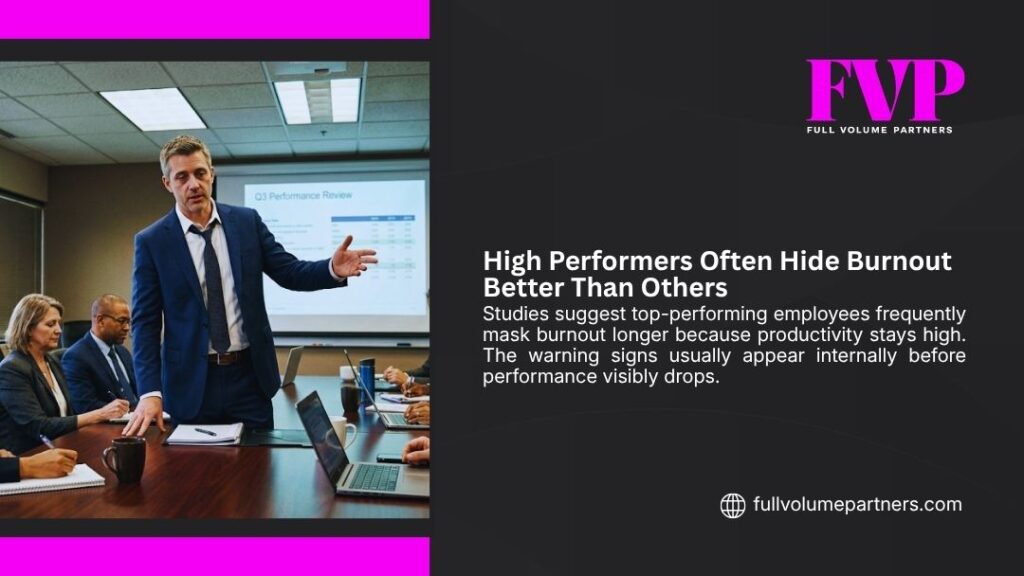
High performance is one of burnout’s best hiding places.
When you are competent, driven, and used to pushing through discomfort, the early signs blend into your normal operating mode. You are wired to keep going. Slowing down feels like a personal failure rather than a sensible response to depletion.
Research from McQuaid found that 55% of the workforce is currently quietly cracking, maintaining professional performance while experiencing significant internal distress.
Those individuals are 6.2 times more likely to slide into full clinical burnout if the pattern continues unaddressed.
| Risk Factor | How It Masks Burnout |
| Perfectionism | Keeps output high even as internal resources deplete |
| Over-responsibility | Makes stopping or delegating feel like letting people down |
| High competence | Allows functioning at reduced capacity for longer |
| Identity tied to performance | Makes acknowledging struggle feel threatening |
The Role of Perfectionism and Over-Responsibility
People who care deeply about their work are the ones most likely to override their own warning signals. They keep saying yes. They keep improving. They keep postponing rest because there is always one more thing to deliver.
Being successful but unhappy is often directly connected to this pattern. The same drive that produced the results is delaying recognition of what those results cost.
Why Competence Can Hide Burnout
External success can completely mask internal depletion. You are still praised. Still trusted. Still delivering. But the effort required to produce the same output has quietly doubled.
Being burned out and not knowing it is especially common here. The results look the same from the outside. Nobody flags a problem. So you do not either.
The Emotional Cost of Pushing Through
Sustained coping eventually turns into numbness. When you push through discomfort long enough, the discomfort stops registering. It becomes your baseline.
What To Do If This Sounds Familiar
Recognition is the first step. It is also the hardest one for driven professionals, because admitting a pattern requires stepping outside the identity that has powered performance for years.
| What To Do | Why It Helps | How To Start Today |
| Audit your energy patterns | Identifies chronic vs. situational depletion | Track how you feel before and after specific tasks |
| Remove one commitment | Lowers load without requiring dramatic change | Decline one meeting or task this week |
| Take a genuine break | Allows the nervous system to begin recovering | Unplug fully for one afternoon without filling the time |
| Talk to someone | Externalizing the pattern breaks the internal loop | One honest conversation with a trusted person |
| Seek professional support | Addresses root causes, not just surface symptoms | Research therapists or coaches with burnout experience |
Do a Quick Self-Check
Before doing anything else, ask yourself:
- Has rest stopped feeling restorative?
- Do you feel emotionally detached from work you used to care about?
- Has motivation shifted from genuine engagement to simply getting through?
- Have these patterns lasted weeks or months rather than days?
If the answer to most of those is yes, what you are experiencing is likely more than temporary stress.
Take One Small Recovery Step Today
The goal is not to change your entire life overnight. That kind of pressure is part of what got you here.
Start with one thing. Remove one unnecessary commitment, take one genuine break, have one conversation you have been avoiding. These small acts may feel small, but they are the beginning of a different pattern.
For those who are feeling unfulfilled after career success, this is often where the shift begins: not with a dramatic restructure, but with one honest acknowledgment.
Know When To Get Extra Help
If symptoms have been present for months, if your mood is consistently low, or if daily functioning is genuinely affected, professional support is the right move.
Research published in Frontiers in Psychology confirmed that a distinct subgroup of burnout cases involves recovery periods exceeding one year, with some cognitive impacts lasting two to seven years after initial diagnosis.
The earlier you address it, the shorter the recovery tends to be.
Frequently Asked Questions
Can you be burned out and not know it?
Yes, you can be burned out and not know it. Approximately 19% of HR leaders estimate at least half their workforce is experiencing silent burnout right now without detection. The functioning appearance is precisely what makes self-recognition so difficult.
What are the first signs of burnout?
Early signs typically include persistent fatigue, reduced motivation, irritability with small triggers, brain fog, and emotional detachment from work you used to care about. These often appear well before performance visibly drops.
How do I know if I am burned out or just stressed?
Stress is usually temporary and tied to a specific pressure. Burnout is more chronic, and rest does not fully resolve it. If your energy does not return after time off, the cause is likely deeper than situational stress.
Can high performers get burned out without realizing it?
Consistently, yes. Competence, perfectionism, and strong work identity allow high performers to mask depletion for longer. Being burned out and not knowing it is especially common in this group because output remains visible even while internal resources deplete.
Does burnout always mean hating your job?
Burnout doesn’t mean that you’re hating the job you’re doing. Many people experiencing burnout still care about their work. What they lose is the energy, emotional capacity, and clarity to engage with it.
Being burned out and not knowing it often looks like someone who is still committed but running well below their actual capacity.
The Pattern Has a Name. Now You Can Act on It.
Full Volume Partners works directly with founders, executives, and high-performing professionals who are carrying more than their external results show.
The work focuses on:
- Identifying what is driving the depletion beneath the performance
- Rebuilding strategic clarity when direction has gone foggy
- Reconnecting ambition with sustainable energy so output and fulfillment start working together again
If being burned out and not knowing it sounds like where you are right now, that recognition is worth taking seriously. Connect with Full Volume Partners today and start building a foundation that can actually hold the results you are working toward.

