
If you have been asking why success doesn’t feel like enough, the answer is not that something is wrong with you. It is that achievement and fulfillment are two separate systems, and most high achievers spend years building one while the other quietly runs dry.
This article breaks down the psychology behind the gap, maps the most common causes, and gives you a way to tell which one is actually driving the experience.
Why Success Doesn’t Feel Like Enough?
The distance between what was accomplished and what was actually felt is one of the most consistent experiences among high performers, and one of the least openly discussed.
Success solves external problems. It creates income, recognition, and status. What it rarely creates on its own is meaning, genuine satisfaction, or a stable internal sense of worth.
When those are absent, success doesn’t feel like enough, regardless of how objectively real the result is.
If you have been feeling unfulfilled after career success, that gap between what the achievement delivered and what you actually needed from it is almost always the starting point.
| External Success | Internal Satisfaction | Short-Term Emotional Relief |
| Title, income, visible results | Meaning, alignment, genuine pride | Brief dopamine spike after the win |
| Earned through performance | Built through values and connection | Fades within days or weeks |
| Finite: it can be reached | Ongoing: requires consistent attention | Replaced quickly by the next target |
Why Achievement Can Feel Emotionally Empty?
The post-achievement crash is not unusual. In most cases, it is predictable.
DHR Global’s 2026 Workforce Trends Report found that 75% of workers worldwide now report some degree of burnout. Among knowledge workers, that figure reaches 83%. The fastest-growing driver was not workload.
The gap between effort and felt reward is what drives why success doesn’t feel like enough for so many driven people.
| What People Expect After Success | What It Often Feels Like in Reality |
| Lasting pride and confidence | A brief high, then a return to normal |
| Clarity about what comes next | Restlessness, confusion, or flatness |
| Validation finally filling the internal gap | Temporary relief, then the goalpost moves |
| Motivation to keep going | Exhaustion that does not resolve with rest |
The Hedonic Treadmill and Why It Matters
The hedonic treadmill describes the brain’s tendency to return to a baseline level of happiness regardless of what happens externally. Wins, promotions, and major milestones produce a genuine emotional response, but one that fades faster than expected.
Brickman and Campbell’s foundational research documented this clearly: even among lottery winners, reported happiness levels returned toward baseline over time. Every new achievement resets the comparison point rather than permanently raising satisfaction.
| Stage | Emotional Experience | What Happens Next |
| Before the goal | High motivation, anticipation | Identity tied to reaching the milestone |
| At the goal | Brief satisfaction or relief | Adaptation begins almost immediately |
| After the goal | Flatness, restlessness, “what now?” | The bar moves, or the emptiness persists |
Why Do I Feel Empty After Success?
The most consistent answer is that the achievement was real, but it was built on a foundation that was never addressed. Success can quiet external pressure temporarily. It cannot replace meaning, connection, or a genuine sense of being enough.
As Viktor Frankl wrote in Man’s Search for Meaning:
“For success, like happiness, cannot be pursued; it must ensue, and it only does so as the unintended side effect of one’s personal dedication to a cause greater than oneself.”
The hedonic treadmill is the brain responding exactly as it was built to, until something larger than the next milestone becomes the anchor.
A 2025 Psychology meta-analysis examining over 11,000 participants found that 62% of knowledge workers experience impostor syndrome, reporting that their internal experience has not kept pace with their external results.
Feeling empty after success rarely points to ingratitude or lack of ambition. It points to a gap between performance and genuine alignment, two things that look similar from the outside but operate completely differently.

The Hidden Reasons High Achievers Keep Feeling “Not Enough”
Why success doesn’t feel like enough often comes down to a small set of named, workable patterns. The issue is that most people skip the diagnosis entirely and go straight to a new goal.
| Possible Cause | What It Feels Like | Daily Signs |
| Conditional self-worth | “I am only enough when I produce” | Guilt during rest, anxiety between projects |
| Moving goalposts syndrome | Satisfaction is always one target away | Wins get downplayed, the bar shifts immediately |
| Identity gap | The person and the role no longer match | Performing a version of yourself that no longer fits |
| Post-achievement depression | Emptiness after the win, not before | Flatness, disconnection, reduced motivation |
| Impostor feelings | Success doesn’t feel satisfying because it doesn’t feel real | Persistent fear of being exposed despite real results |
Conditional Self-Worth
When self-worth is tied to performance, each win only delivers briefly.
Psychologists Jennifer Crocker and Connie Wolfe identified what they called “contingencies of self-worth,” domains where people learn to stake their entire sense of value.
In high achievers, this is almost always organized around output.
Research consistently shows that tying self-worth to performance increases anxiety, depression, and burnout over time. You become only as good as your last result. That is a cycle success alone cannot break.
The Identity Gap Behind “Accomplishment Feels Empty”
Many high achievers spend years building toward a version of themselves that looks successful from the outside. When they get there, the person they have become and the person they expected to be are not the same.
This is at the core of why success doesn’t feel like enough for people who have genuinely earned it.
As Adam Grant writes in “Think Again”:
“Foreclosing on one identity is like following a GPS that gives you the right directions to the wrong destination.”
If you have been feeling lost after achieving your goals, or have noticed that you feel accomplished everything but still not happy, the identity gap is almost always the pattern underneath.
| External Identity | Internal Reality |
| Title, results, external recognition | Who you actually are outside the role |
| What others see and measure | What genuinely energizes or gives you meaning |
| Built through years of performance | Often unexamined during those same years |
How to Tell What Is Really Driving the Feeling
Why success doesn’t feel like enough is not one problem. There are several, and they do not resolve the same way.
Is It Burnout, Perfectionism, or an Identity Issue?
Research from a 2025 Newsweek survey found that Gen Z and millennials reach peak burnout at an average age of 25, earlier than any previous generation.
| Possible Cause | Typical Signs | What to Do Next |
| Burnout | Exhaustion, cynicism, depletion | Rest first, reduce the load |
| Perfectionism | The win arrives and immediately feels small | Examine the standard, not the achievement |
| Identity gap | No clear sense of self outside the role | Values audit, not a new goal |
| Post-achievement depression | Flat for weeks after a milestone | Name it; seek support if it persists |
When the Problem Is Not Success, but Pace
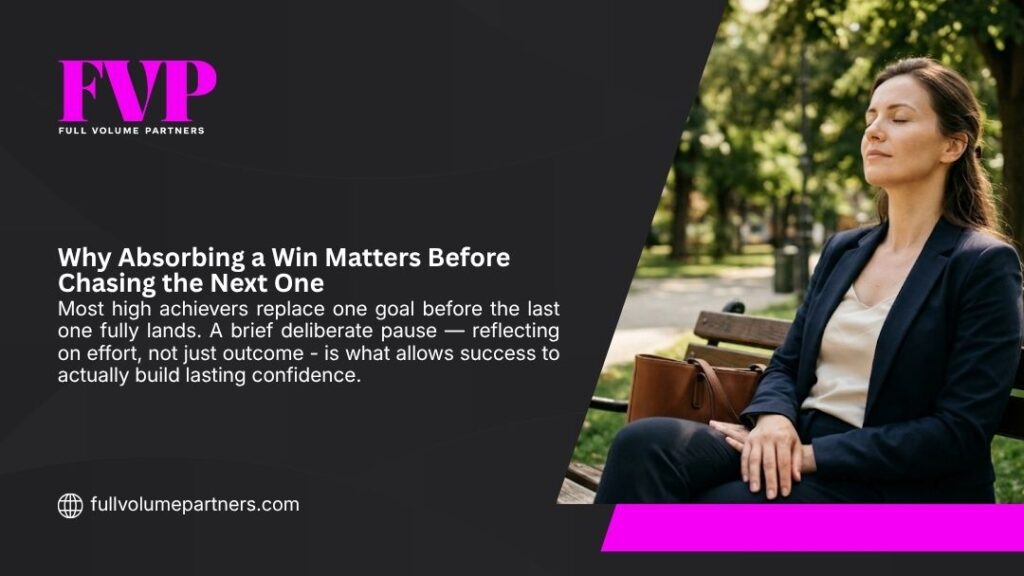
Sometimes accomplishment feels empty because it was never fully absorbed. One milestone gets replaced by the next before the emotional cycle has space to complete.
Signs that pace is the problem, not achievement:
- Difficulty recalling specific wins from the past 12 months
- A sense that results are checked off rather than genuinely felt
- Moving to the next goal while still processing the last one
- Exhaustion that arrived before any clear crisis did
What To Do When Success Still Feels Hollow
The goal is not to stop being ambitious. The goal is to make ambition produce something that actually lands.
A meta-analysis of 127 studies involving 77,560 participants found that intrinsic motivation is significantly more strongly associated with sustained performance than extrinsic motivation, with effect sizes of r = .298 versus r = .176.
Goals rooted in values and genuine interest outperform goals driven by status or external validation in both output and satisfaction.
| Step | What It Means | How to Start |
| Pause | Stop replacing the goal before naming what you feel | Take one week before committing to the next target |
| Name the driver | Identify whether it is burnout, perfectionism, or identity | Match your experience to the patterns above |
| Audit your values | Ask what you were really chasing, not just what you got | Write down three things that energize you with no metric attached |
| Reduce external pressure | Stop defining success by someone else’s measure | Set one firm personal boundary this week |
| Seek support | Know when reflection alone is not enough | A therapist, coach, or strategic advisor |

Reframe Success as Evidence, Not Identity
When achievement becomes the only measure of worth, success stops building confidence and starts creating anxiety. The win feels insufficient because it was never designed to answer the question underneath it.
As Dr. Susan David, Harvard Medical School psychologist and author of Emotional Agility, puts it:
“Values serve as a kind of psychological keel to keep you steady.”
Without that keel, each new result sends the whole structure tilting toward the next requirement.
If you have been dealing with a lost sense of self after years of overachieving, this is almost always the reframe where the pattern begins to shift. The work is separating what you achieved from what it means about you.
Create Room to Actually Feel the Win
Before moving to the next goal, a short deliberate reflection changes what the achievement actually delivers.
- Write down what was genuinely hard about the process, not just the outcome
- Name what changed because of the effort
- Identify one thing that mattered in how it happened
- Sit with being done before rushing toward what comes next
This is why success doesn’t feel like enough shifts from a permanent condition to a temporary one.
Frequently Asked Questions
Why success doesn’t feel like enough: is it a common experience?
Yes, research consistently shows that the gap between external achievement and internal fulfillment is one of the most widespread yet underreported experiences among high performers.
It reflects that achievement and fulfillment depend on different inputs and require different attention.
Why do I feel empty after achieving a big goal?
Feeling empty after success is largely explained by hedonic adaptation. The brain returns to its emotional baseline faster than expected after any achievement. The anticipation of a goal generates more sustained emotional energy than the completion of it ever does.
Is this post-achievement depression?
Post-achievement depression is a recognized pattern. If the flatness persists beyond a few weeks, affects multiple areas of your life, and does not improve with rest, speaking with a professional is the appropriate next step.
How do I know if this is burnout or a value problem?
Burnout tends to show up as exhaustion and depletion from sustained overwork. A values problem shows up as emptiness even after rest, or a sense that the entire direction no longer fits. Both can coexist, and they require different responses.
Why do I keep moving the goalpost after every win?
Moving goalposts syndrome is almost always driven by conditional self-worth: the belief that one more result will finally produce the feeling of being enough. Research shows it does not. The pattern requires examining the standard, not continuing to raise it.
What This Feeling Is Actually Telling You
Why success doesn’t feel like enough is not a motivation problem. It is a signal that external performance and internal fulfillment are running on separate tracks, with nearly all the investment going to one side.
The achievement was real. The work was real. What is missing is the internal foundation that allows results to actually land rather than slide toward the next requirement.
Full Volume Partners works directly with founders, executives, and growth-stage professionals who have built real results but feel disconnected from where those results are taking them. The work is strategic, execution-focused, and built around where you actually are.
If success doesn’t feel like enough is a question you have been carrying, the work starts with an honest conversation. Connect with Full Volume Partners today and start building from a stronger foundation.

