
55% of American workers say they get their sense of identity from their job. Among college graduates and professionals, that number rises to 70%, according to Gallup data.
For the most educated, highest-achieving segment of the workforce, career and selfhood have almost fully merged.
Burnout hits, a role changes and success arrives and still feels hollow. But somewhere in your mind, a question starts forming: who am I outside of my career?
This article explains why that question is hard to answer, what building a real identity outside of work actually involves, and how to start the process practically, without abandoning ambition or pretending the career doesn’t matter.
Who Am I Outside of My Career? Start by Separating the Role From the Person
A job title describes what you do inside a specific organization, in a specific context, for a specific period. It is not a personality.
The confusion is understandable. Work structures your schedule, your social circle, your daily sense of progress, and often your self-worth. When it performs that many functions, it starts to feel like identity, because it is doing identity’s job.
If you’re feeling unfulfilled after career success, this is almost always where the disconnect begins. The career delivered what it promised externally. It was never designed to answer a deeper question.
| Source of Worth | Career Identity | Whole-Person Identity |
| Examples | Title, income, output | Values, relationships, interests, growth |
| What it measures | Performance against external standards | Alignment with internal meaning |
| Main risk | Emptiness when performance dips | Requires intentional, ongoing investment |
| What expands it | Promotion, recognition | Connection, curiosity, purpose |
Why This Question Feels So Hard to Answer
Many high achievers have spent years building exclusively around professional milestones. The question “who am I outside of my career?” feels unfamiliar not because the answer doesn’t exist, but because no space was ever made to ask it.
There is also fear underneath it. If work is removed from the picture, even mentally, what remains? That uncertainty is uncomfortable enough that most people avoid the question until something forces it.
The discomfort is itself information. It signals how much identity has been compressed into one domain.
What Identity Outside Work Actually Includes
Identity is not one fixed thing. It is a combination of roles, values, interests, and relationships that evolve over time.
Outside of work, it can include:
- Who you are to other people: friend, partner, sibling, parent, mentor
- What you care about: fairness, creativity, learning, connection, growth
- What gives you genuine energy: movement, making things, deep conversation, being in nature
- What you believe and how you live when no one is measuring
| Identity Bucket | Plain Language Examples |
| Roles | Friend, caregiver, sibling, learner, community member |
| Values | Honesty, curiosity, courage, generosity, creativity |
| Interests | Reading, cooking, building, sport, travel, music |
| Energy sources | What leaves you calmer, lighter, or more present afterward |
Why Work Becomes Your Identity in the First Place
This is not a character flaw. It is a predictable outcome of how professional life is structured.
Achievement gets praised early. The people who excel receive recognition, feedback, and more responsibility. Over time, the loop tightens: perform well, receive validation, feel good about yourself.
That trains people to treat external performance as the measure of personal worth.
Add long hours, a culture that equates productivity with character, and professional environments where value is constantly being assessed, and it becomes almost logical that work absorbs identity.
According to Mercer’s Global Talent Trends report, 82% of employees are at risk of burnout, yet fewer than half of employers have redesigned work with wellbeing in mind.
The system accelerates this pattern without addressing what it costs.
| Common Trigger | Emotional Effect | How It Shows Up Day to Day |
| Achievement culture | Ties self-worth to output | Guilt when not being productive |
| External praise for performance | Makes approval the validation source | Anxiety when work receives criticism |
| Long working hours | Crowds out non-work identity | No space for personal interests |
| Social comparison | Reinforces status-based thinking | Constant benchmarking against peers |
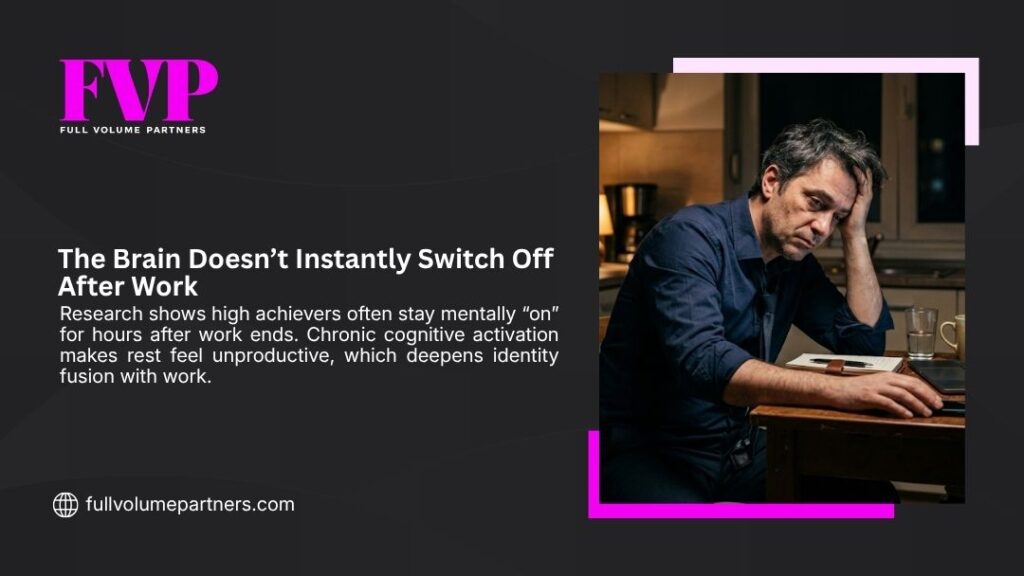
Signs Your Career Has Absorbed Your Self-Worth
Some signs are loud. Others are quieter and easier to rationalize.
- You feel guilty when you are not being productive, even on weekends
- Career setbacks feel personal rather than situational
- You struggle to describe yourself without mentioning your job
- You feel restless or directionless without a professional goal to chase
- You depend on external praise to feel confident about your own abilities
If you’re dealing with a lost sense of self after years of overachieving, this is usually the pattern that needs naming before anything else can shift.
Why Success Can Still Feel Empty
“People admire what you do, but you still don’t know who you are without it.”
The Global Flourishing Study, identified six dimensions of genuine flourishing: happiness and life satisfaction, mental and physical health, meaning and purpose, character and virtue, close social relationships, and financial security.
Career performance does not appear as a direct component. Relationships, meaning, and purpose show up in every dimension that actually matters.
A Practical Identity Audit to Find Who You Are Beyond Work
This is not a philosophical exercise. It is a short, structured process you can work through in one sitting.
| Category | Prompt | What to Notice |
| Values | What matters to you even when no one is watching? | Patterns across your actual choices |
| Roles | Who are you to the people in your life outside work? | The relationships that give you meaning |
| Interests | What did you enjoy before career pressure took over? | Energy sources that predate achievement |
| Energy | What leaves you lighter rather than heavier? | The difference between competence and aliveness |
| Contributions | How do you show up outside of professional output? | What you give in family or community |
Identify Your Values Before Your Hobbies
Most self-discovery advice skips straight to activities. But if you don’t know what you care about, a list of hobbies won’t give you direction.
Start here:
- What kind of person do I want to be, separate from what I achieve?
- What do I want people who know me personally to say about me?
- What would I prioritize if performance stopped being the primary metric?
Values are the foundation. Interests, habits, and roles build on top of them.
Name the Roles You Play Outside Your Job
Identity is already present in the roles you occupy daily, even if you haven’t labelled them.
These are not secondary to career. For most people, they are the relationships that hold real meaning when everything else is stripped back.
Notice What Gives You Energy, Not Just What You Are Good At
Competence and being alive are different things. You can be highly skilled at something that quietly drains you.
| Drains Energy | Restores Energy |
| Constant performance pressure | Creative work with no external audience |
| Social events that feel obligatory | Conversations that go somewhere real |
| Being professionally “on” all day | Physical movement or time in nature |
| Checking outputs and metrics | Quiet time with a small group or alone |
The question is not “what do I do well?” It is “what leaves me more present and alive than I was before?”
What to Do Next When You Still Do Not Know the Answer
When you catch yourself quietly thinking, who am I outside of my career? and drawing a blank, that is the starting point. Most people asking this question are at the beginning of a process, not at the end of one.
The goal is not to solve identity over a weekend. It is to start building small, deliberate non-work experiences and pay attention to what generates any kind of real response.
| Action | Time Needed | What to Notice |
| Try one non-work activity with no goal attached | 1 to 2 hours | How you feel after, not just during |
| Spend time with someone outside your professional network | One evening | What topics come up naturally |
| Set one firm work boundary this week | Immediate | How uncomfortable it is to protect personal time |
| Revisit something you enjoyed before your career took over | One afternoon | Whether any energy returns |
| Answer one honest journal prompt about identity outside work | 15 minutes | What feels true vs. what feels performed |
How to Start When You Feel Numb or Stuck
If you have no clear hobbies and no energy to explore, start smaller. One question per week, one activity with no productivity goal attached, one conversation that has nothing to do with professional performance.
Identity is not rebuilt in a single decision. It is rebuilt through small, repeated choices to invest in something that isn’t output.
How to Stay Ambitious Without Making Work Your Whole Identity
This is the concern most high achievers carry into this process: if I build identity outside work, will I lose my edge?
The data says no. The 2026 State of Work-Life Wellness Report found that 89% of workers perform better when they actively prioritize their wellbeing.
Ambition that coexists with health, relationships, and meaning is more durable than ambition running on depletion.
The World Economic Forum’s Future of Jobs Report found that two-fifths of existing skill sets will be transformed or become outdated between 2025 and 2030.
In a career landscape that is volatile, an identity tied to a single role or title is structurally fragile.
And if you have been asking yourself “why do I feel burned out even though I’m successful”, the answer almost always involves this gap. The drive never disappeared. The foundation it was running on became too narrow to hold it.
What If My Answer Changes Over Time?
It will. Identity responds to seasons, relationships, age, and what you go through. Someone who defined themselves as a builder in their 30s may value community or rest more in their 40s.
The goal is not to find one permanent answer. It is to stay honest about what is actually true right now.
Frequently Asked Questions
Who am I outside of my career?
Your identity outside work is built from your values, the roles you play in other people’s lives, what gives you genuine energy, and what you care about when no one is measuring. It takes time to surface because work has filled most of the available space.
Why do I feel empty even when my career is going well?
The Global Flourishing Study identifies six dimensions of genuine wellbeing. Career performance alone cannot fulfill all of them.
When relationships, meaning, and personal health remain underdeveloped, external success produces emptiness regardless of how much is achieved.
How do I separate my identity from my job?
Start by identifying what work has been providing: structure, self-worth, social connection, or purpose. Then find alternative sources for each, one at a time. The goal is not complete separation but diversification.
What if I do not have hobbies or interests?
Most people who say this spent years prioritizing professional performance above everything else. Interests do not disappear. They need space and permission to come back. Start with what you were drawn to before career pressure became the dominant force.
Identity Is More Than a Job Title. Let’s Build the Full Picture.
Full Volume Partners works directly with founders, executives, and growth-stage professionals who have built strong careers but feel disconnected from who they are beyond them.
The work focuses on:
- Identifying where career success has replaced deeper personal direction
- Rebuilding a sense of self that supports both ambition and meaning
- Creating a foundation that holds long-term growth without requiring depletion
If the question “who am I outside of my career?” has been sitting in the background longer than you’d like to admit, that recognition is worth acting on.
Connect with Full Volume Partners and take the first honest step toward clarity.

