
Perfectionism and burnout in women leaders describes a well documented pattern: the drive to meet impossibly high standards gradually depletes the same energy that built a leader’s success in the first place.
This guide breaks down why perfectionism and burnout in women leaders are so tightly connected, how gender expectations intensify the pressure and practical ways to sustain ambition without paying for it with your health.
Perfectionism and Burnout in Women Leaders: Why the Connection Is So Strong
If perfectionism helped you succeed, why does it eventually leave you exhausted? The answer lies in a distinction most advice ignores.
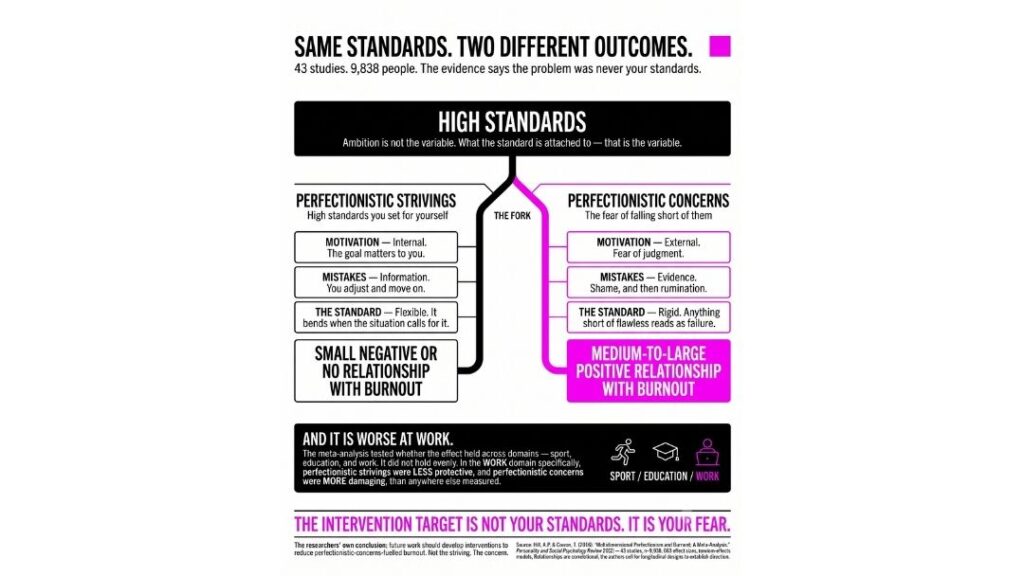
Healthy striving involves flexible, self-set goals pursued because they matter to you, with room to adjust when circumstances change.
Perfectionism involves rigid, often externally driven standards where anything short of flawless feels like failure, regardless of whether the situation actually called for that level of precision.
Identity-based achievement adds another layer. When self-worth becomes fused with output, every setback threatens something larger than the task at hand.
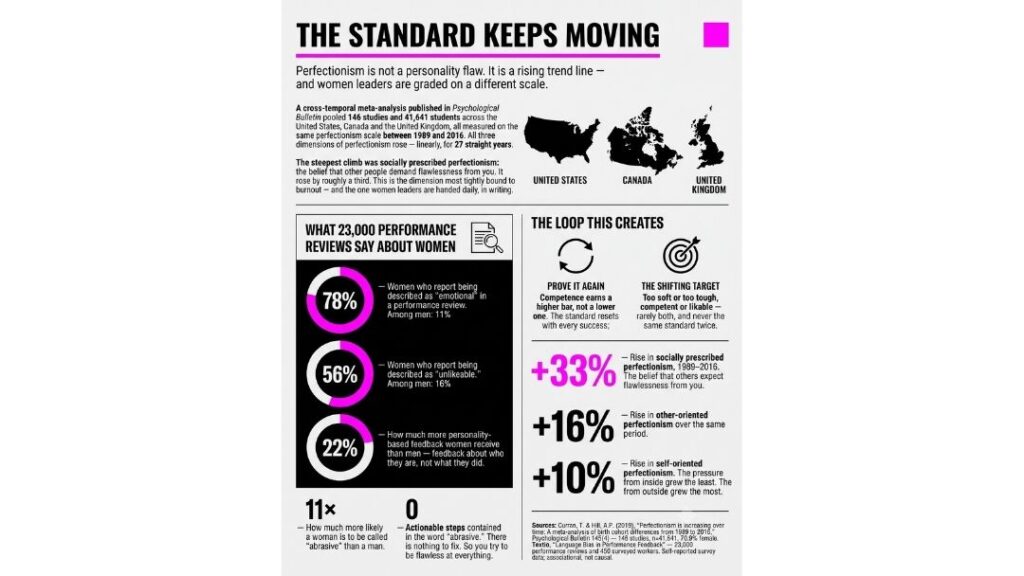
Socially prescribed perfectionism, the belief that others expect flawlessness from you, compounds this further. It shows up constantly in roles where every decision is visible.
| Excellence | Perfectionism | |
| Standard | High but flexible | Rigid and absolute |
| Motivation | Internal, values driven | Fear of judgment or failure |
| Response to mistakes | Learns and adjusts | Shame and rumination |
| Sustainability | Holds up long term | Erodes over time |
This is the exact mechanism behind feeling burned out even though successful on paper, output stays high while internal resources quietly disappear.
The Difference Between High Standards and Perfectionistic Thinking
Ambition itself is not the problem. A leader who revises a presentation once or twice to sharpen the message is exercising judgment. A leader who revises it ten times after it already meets every requirement is responding to fear, not strategy.
Why Success Often Masks Burnout for Women Leaders
The people who appear strongest are often the last to recognize they need support.
High-functioning burnout lets external achievement continue while internal capacity quietly depletes, which is exactly why so many leaders spend months being burned out and not knowing it before naming what is actually happening.
Why Women Leaders Experience Perfectionism Differently
Why do so many accomplished women feel they must be exceptional just to be considered competent?
Gender expectations create pressures that compound perfectionism well beyond ordinary ambition, and this is where perfectionism and burnout in women leaders starts to look different from burnout in general.
| Expectation | Contradiction Created | Emotional Impact | Burnout Consequence |
| Be assertive | But not aggressive | Constant self-monitoring | Decision fatigue |
| Be ambitious | But not self-promoting | Undersold contributions | Overcompensation through overwork |
| Be confident | But approachable and humble | Exhausting emotional calibration | Reduced authenticity at work |
The Double Bind That Fuels Perfectionism and Burnout in Women Leaders
Catalyst’s long-running research on women in leadership identifies three specific predicaments: women are perceived as too soft or too tough but rarely “just right,” held to a higher competence threshold than men for the same rewards, and seen as competent or likable, but rarely both.
A promotion scenario captures this well, the same assertiveness that reads as leadership in a man often gets read as abrasive in a woman, so perfectionism becomes a defense against a standard that shifts depending on who is being judged.
Emotional Labor and the Competence Trap
Reliable performance tends to generate more responsibility, not more support.
A 2018 Harvard Business Review analysis of workplace research found that women volunteer for and get assigned non-promotable tasks.
The ones that keep an organization running but rarely advance a career, more often than men, and are more likely to say yes when asked.
Reliable performance leads to more responsibility, which leads to less delegation, which leads to greater exhaustion. Team caregiving, conflict mediation, and informal mentorship all pile onto an already full plate without ever appearing on a scorecard.
The Hidden Signs of Burnout in High-Achieving Women Leaders
Burnout does not always look like collapse. Sometimes it looks like continued success, which is exactly why perfectionism and burnout in women leaders gets missed until performance itself finally starts to slip.
The signs of burnout in high achieving women rarely resemble a dramatic breakdown. They look like constant overpreparation, quiet delegation anxiety, and irritability that surfaces in small moments rather than obvious ones.
Early warning signs of high-functioning burnout to watch for:
- Constant overpreparation on tasks that do not require it
- Delegation anxiety, even for low-stakes decisions
- Irritability that shows up in small, easy-to-dismiss moments
- Inability to rest without guilt
- Loss of creativity or curiosity
- Decision fatigue by early afternoon
A founder who still closes every deal and hits every deadline while quietly feeling emotionally detached from the business she built is not an exception. She is the pattern this section describes.
When Rest Feels Like Failure
Productivity guilt runs deep when self-worth has been built through output for years. Rest starts to feel like something that must be earned rather than something the body and mind require regardless of output.
Why Delegation Feels Harder Than Working Longer Hours
Trust concerns, fear of disappointing others, and control used as emotional safety all make delegation feel riskier than simply doing the work yourself, even once the workload has become unsustainable.
A task handed off can come back imperfect, and for a leader whose identity runs through flawless execution, that risk often feels bigger than the exhaustion of carrying everything alone.
How to Break the Cycle of Perfectionism and Burnout Without Lowering Your Standards
What if sustainable leadership required excellence rather than perfection? Breaking the cycle of perfectionism and burnout in women leaders does not mean lowering your standards. It means changing what those standards are attached to.
| Old Belief | Healthier Reframe | Leadership Benefit |
| Every detail must be flawless | Prioritize what actually moves the outcome | More time for strategic decisions |
| Delegating means losing control | Delegating means scaling your impact | Team capability grows |
| Rest must be earned | Rest maintains performance | Sustained decision quality |
Redefine Success Around Excellence, Not Flawlessness
Good-enough standards on lower-stakes work protect the energy needed for decisions that actually matter.
An executive who stops refining a slide deck the moment it clearly communicates the point, and redirects that time toward the decision the deck was meant to support, is prioritizing business impact over endless polish.
Strategic priorities require this kind of triage, deciding in advance which tasks deserve full effort and which simply need to be finished.
Build Delegation Systems Instead of Personal Heroics
Clear decision ownership and defined accountability replace the exhausting default of doing everything yourself.
- Delegate recurring operational tasks outright
- Retain only the decisions that require your specific judgment
- Develop a team member’s skills so a task can move off your plate permanently
Separate Self-Worth From Achievement
Identity diversification protects against the exact pattern behind lost sense of self after years of overachieving, where a leader’s entire sense of self has been built on professional output alone.
Boundaries and rest become maintenance, not a reward that has to be earned through exhaustion first.
What Organizations Can Do to Reduce Burnout Among Women Leaders
Burnout is not only an individual problem. It is often reinforced by organizational culture.
| Individual Behaviors | Team Practices | Organizational Policies |
| Set explicit boundaries | Distribute non-promotable tasks fairly | Recognize invisible labor formally |
| Delegate deliberately | Normalize asking for support | Build psychological safety into culture |
| Redefine personal success metrics | Share emotional labor across the team | Reward sustainable performance, not just output |
Making Invisible Leadership Work Visible
Mentoring, team care, and emotional management rarely appear in a performance review, yet they consume real time and energy every single week.
Naming this work and distributing it fairly is a structural fix, not a personal one, and it starts with organizations actually tracking who carries it.
Creating Cultures That Reward Sustainability
Organizations that reward constant availability get more perfectionism and burnout in women leaders, not less. Psychological safety and boundary-setting norms, modeled from the top, change what actually gets rewarded.
FAQs About Perfectionism and Burnout in Women Leaders
Can perfectionism be helpful in leadership roles?
Yes, perfectionism can be helpful in leadership roles. High personal standards pursued flexibly support strong performance and resilience. The harmful version, fear-driven perfectionism tied to self-worth and the constant fear of falling short, is what predicts burnout.
Why are women leaders more vulnerable to perfectionism and burnout?
Not because they are inherently more perfectionistic, but because double standards, invisible labor, and uneven feedback add pressure that compounds an already demanding role, making the same standard cost more to maintain.
What are the early signs of high-functioning burnout?
Overpreparation, delegation anxiety, irritability in small moments, and difficulty resting without guilt, all while performance on the surface stays strong.
How can women leaders maintain high standards without becoming perfectionists?
By keeping standards flexible, tying self-worth to values rather than output, and treating good-enough as a legitimate strategic choice on lower-stakes work.
Is burnout always caused by working too many hours?
No, hours matter less than the psychological pattern behind them. Perfectionism and burnout in women leaders often develops regardless of hours worked, driven by fear of failure rather than workload alone.
Sustainable Leadership Requires Excellence, Not Perfection
Perfectionism and burnout in women leaders is not a personal failing or a sign of weak resilience. It is a predictable outcome of fear-driven standards combined with real structural pressure, and both halves of that equation can change.
Recovering who you are outside of your career is often what makes that redefinition possible in the first place. The leaders who sustain ambition longest are the ones who separate their worth from their output.
How Full Volume Partners Helps Women Leaders Break This Cycle
Full Volume Partners works directly with women executives, founders, and senior leaders who are ready to break the pattern of perfectionism and burnout in women leaders without lowering how much they expect from themselves.
The advisory work is built around what actually breaks the cycle, not generic wellness advice:
- A clarity-first approach that separates the standards worth keeping from the ones driven by fear
- Hands-on, embedded partnership that helps build real delegation systems, not just advice to delegate more
- Customized frameworks built around your leadership stage, your organization, and the specific expectations you are navigating
- Direct support addressing the structural drivers of burnout, invisible labor, feedback gaps, and workload distribution, not just individual mindset
- More than 20 years of experience helping ambitious women build leadership that does not require self-sacrifice to sustain
If the patterns in this guide feel familiar, that recognition is worth acting on. Connect with Full Volume Partners today and build a version of leadership where high standards do not cost you your health.

