
Leadership burnout symptoms are the emotional, cognitive, physical, and behavioral warning signs that appear when chronic workplace stress overwhelms a leader’s capacity to recover between demands.
They differ from ordinary fatigue because they build gradually, often behind strong performance, and do not resolve with a weekend off. What if the qualities that made you successful as a leader are the same habits pushing you toward burnout?
What Are Leadership Burnout Symptoms and Why Do Leaders Miss Them?
The World Health Organization classifies burnout as an occupational phenomenon resulting from chronic workplace stress that has not been successfully managed. For leaders, the pressure looks different than it does for individual contributors.
Executives carry constant decision-making responsibility, rarely switch off, and often lack anyone to be honest with about how they are actually doing.
That combination of hyper-responsibility and isolation is what makes burnout in high-performing leaders harder to name than ordinary workplace stress.
| General Employee Burnout | Leadership Burnout | |
| Source of stress | Workload and role clarity | Constant decision-making and accountability |
| Typical symptoms | Fatigue, disengagement | Fatigue plus decision fatigue and isolation |
| Behavioral pattern | Withdrawal, reduced output | Overfunctioning while quietly disengaging |
| Organizational impact | Team-level | Cascades through morale, retention, and strategy |
Why High Performers Are Often the Last to Recognize Burnout
Achievement identity, hyper-responsibility, and delegation guilt keep high performers pushing long after the early leadership burnout symptoms appear. A founder who checks email at midnight despite genuine exhaustion is not showing discipline.
She is an example of why you feel burned out even though successful, where output stays high while internal capacity quietly runs out.
Is Leadership Burnout a Personal Problem or an Organizational Issue?
Growth-stage pressure, always-on culture, and a lack of support systems drive leadership burnout as much as individual habits do.
Leadership Burnout Symptoms vs Stress: How to Tell the Difference
Feeling overwhelmed after a difficult quarter is normal. Feeling emotionally detached from work you once loved is something else entirely.
| Stress | Leadership Burnout | |
| Energy recovery | Returns after rest | Stays depleted even after time off |
| Motivation | Intact | Significantly reduced |
| Sleep quality | Occasionally disrupted | Consistently poor |
| Creativity | Unaffected | Noticeably reduced |
| Emotional state | Anxious but present | Numb or detached |
| Strategic thinking | Clear | Reactive and short-term |
When Normal Stress Becomes Leadership Burnout Symptoms
Maslach’s research identifies three dimensions behind this progression: exhaustion, cynicism, and a reduced sense of effectiveness.
Pressure becomes chronic stress, then exhaustion, then the leadership stress vs burnout line gets crossed once effectiveness itself starts slipping.
The Earliest Leadership Burnout Symptoms Most People Ignore
The first warning signs are usually subtle changes in mindset, not dramatic breakdowns. Loss of curiosity, reduced empathy, and quiet strategic avoidance show up long before anyone would call it burnout.
Many leaders keep performing at a high level while can you be burned out and not know it becomes the exact question they should be asking themselves, since the earliest leadership burnout symptoms rarely feel like burnout from the inside.
| Early Signals | Advanced Symptoms | Business Consequence |
| Loss of curiosity | Complete disengagement | Stalled strategic thinking |
| Mild irritability | Emotional volatility | Damaged team trust |
| Task-switching without progress | Inability to focus | Missed deadlines |
| Feeling productive but not impactful | Sense of futility | Declining decision quality |
You Stop Thinking Strategically and Start Surviving Operationally
Reactive leadership and firefighting mode replace long-term planning. A leader deep in early burnout focuses exclusively on what is urgent, while what actually matters for the business quietly waits.
You Feel Emotionally Present at Work But Mentally Disconnected
Cynicism, reduced enthusiasm, and a fading sense of meaning are some of the quietest signs of leadership burnout, precisely because the leader is still technically showing up.
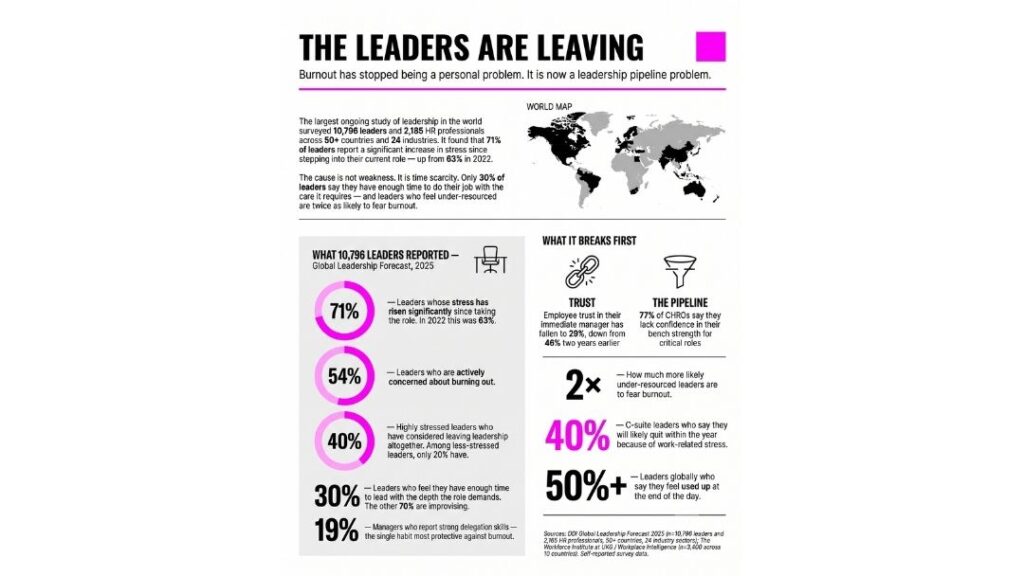
8 Core Leadership Burnout Symptoms Every Executive Should Know
Burnout changes far more than energy levels. It changes how leaders think, communicate, and decide.
Chronic Exhaustion That Rest No Longer Fixes
Persistent fatigue, unrefreshing sleep, and failing to recover even after a full weekend are among the clearest executive burnout symptoms leaders tend to dismiss the longest.
Decision Fatigue and Mental Fog
Slower decisions, second-guessing, and rereading the same email three times before responding are hallmark signs of decision fatigue in leaders, especially those without a team to delegate to.
The average CEO makes roughly 35,000 decisions a day, a volume that leaves little margin once burnout sets in.
Increased Irritability and Lower Frustration Tolerance
Snapping in meetings and reduced patience with people who used to barely register as an annoyance are signs of leadership burnout that colleagues usually notice before the leader does.
Loss of Passion, Motivation, and Purpose
Work becomes an obligation instead of something meaningful. Reduced engagement here often reflects an identity conflict, not a lack of ambition.
Physical Symptoms of Chronic Stress
Headaches, digestive issues, muscle tension, and frequent illness are physical leadership burnout symptoms that often get treated as unrelated health complaints.
| Physical | Emotional | Cognitive | Behavioral |
| Headaches, fatigue | Numbness, cynicism | Brain fog, indecision | Withdrawal, overworking |
| Sleep disruption | Irritability | Memory lapses | Avoiding difficult conversations |
| Frequent illness | Reduced empathy | Narrow thinking | Constant task-switching |
Social Withdrawal and Leadership Isolation
Pulling back from colleagues and feeling alone despite constant team interaction is common.
Half of CEOs report significant loneliness in their role, and the leaders who experience signs of burnout in high achieving women often describe the exact same isolation, regardless of title or industry.
Creativity and Innovation Begin to Disappear
Reduced problem-solving and narrow, tactical thinking replace the visionary thinking that got a leader promoted in the first place.
Can Leadership Burnout Symptoms Affect Decision-Making?
Yes, burnout drives strategic mistakes, analysis paralysis, and risk avoidance, and confidence in decisions drops even when the decisions themselves are still sound.
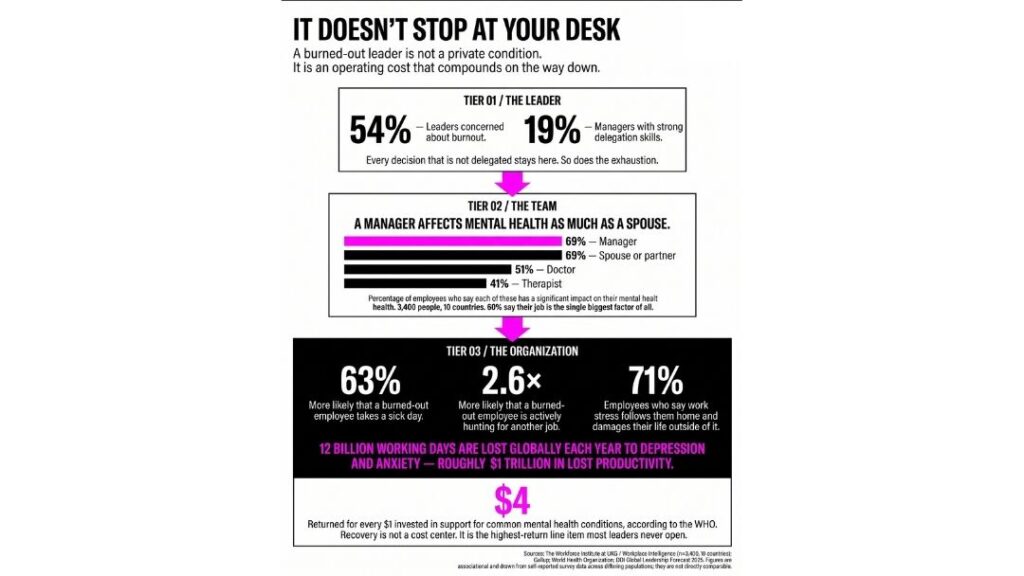
How Leadership Burnout Symptoms Affect Teams and Organizations
Burnout is never purely personal. Leaders transmit energy, priorities, and emotional cues throughout an entire organization, whether they intend to or not.
A burned-out founder who cannot delegate creates constant urgency and uncertainty for everyone reporting to her, even when nothing is actually on fire. Team morale, innovation, and retention all absorb the cost of unmanaged leadership burnout symptoms.
The Hidden Business Costs of Executive Exhaustion
Strategic drift, poor hiring decisions, reduced innovation, and rising turnover follow burned-out leadership. A 1,000-person company can lose up to $5 million a year to burnout-driven disengagement alone.
What To Do If You Recognize Leadership Burnout Symptoms in Yourself
Recognizing burnout early is not a weakness. It is one of the most valuable leadership skills you can develop.
| Action | Leadership Benefit | Time Horizon |
| Audit your actual workload | Removes hidden energy drains | Immediate |
| Delegate one recurring decision | Reduces decision fatigue | 2 to 4 weeks |
| Build a peer support structure | Reduces isolation | Ongoing |
| Set explicit availability boundaries | Protects recovery time | Immediate |
Ask Whether You Need Rest or a Different Way of Leading
Temporary exhaustion responds to rest. Structural burnout does not, and it often points to unsustainable habits like perfectionism and burnout in women leaders, where every task still runs through one person by default.
Build Sustainable Leadership Practices Before Burnout Becomes a Crisis
Delegation, protected recovery routines, and team empowerment prevent high-functioning burnout from becoming a full leadership crisis.
For leaders further along in recovery, structured executive burnout recovery for women principles apply just as directly here, since the underlying stages stay consistent regardless of title.
Leadership Burnout Symptoms FAQ
What are the earliest leadership burnout symptoms?
Loss of curiosity, mild irritability, and feeling productive without feeling impactful are usually the first signs, appearing well before exhaustion becomes obvious to anyone else.
Can leaders experience burnout while still performing well?
Yes, high-functioning burnout allows strong output to continue for months while internal capacity quietly depletes underneath it, which is exactly why it goes unnoticed for so long.
How is leadership burnout different from workplace stress?
Stress resolves with rest and a clear end point. Burnout is chronic, affects motivation and identity, and requires structural changes, not just time off.
Why do high achievers ignore burnout symptoms?
Because they are still functioning at a high level. Achievement-oriented leaders tend to rationalize early warning signs as a demanding season rather than a systemic problem worth addressing.
Can burnout affect decision-making abilities?
Yes. It drives slower decisions, reduced confidence, and increased risk avoidance, even when a leader’s underlying judgment remains technically sound.
How Full Volume Partners Supports Leaders Through This
Full Volume Partners works directly with founders, executives, and senior leaders who are ready to lead at a high level without running themselves into the ground to do it.
The advisory work is built around what actually addresses leadership burnout symptoms at the root, not surface-level wellness advice:
- A clarity-first approach that turns a vague sense of exhaustion into a specific, prioritized plan
- Hands-on, embedded partnership that stays through implementation, not a one-time workshop you are left to apply alone
- Customized frameworks built around your leadership stage, your organization, and your actual constraints
- Direct support with the structural bottlenecks that cause burnout: decision load, delegation gaps, and unclear positioning, so performance stops depending entirely on one person
- More than 20 years of experience helping ambitious leaders build organizations that do not require self-sacrifice to succeed
If the symptoms in this guide feel familiar, that recognition is worth acting on. Connect with Full Volume Partners today and build the version of your leadership that does not require burning out to sustain it.

